Decimal to Fraction Chart: Inches, Repeating Decimals & Easy Conversion
A decimal to fraction chart for inches, plus easy steps to convert any decimal, handle repeating decimals and round to the nearest 1/16 inch.
Sanjay Singh
Published on 24 Oct 2026 • Updated on 24 Oct 2026
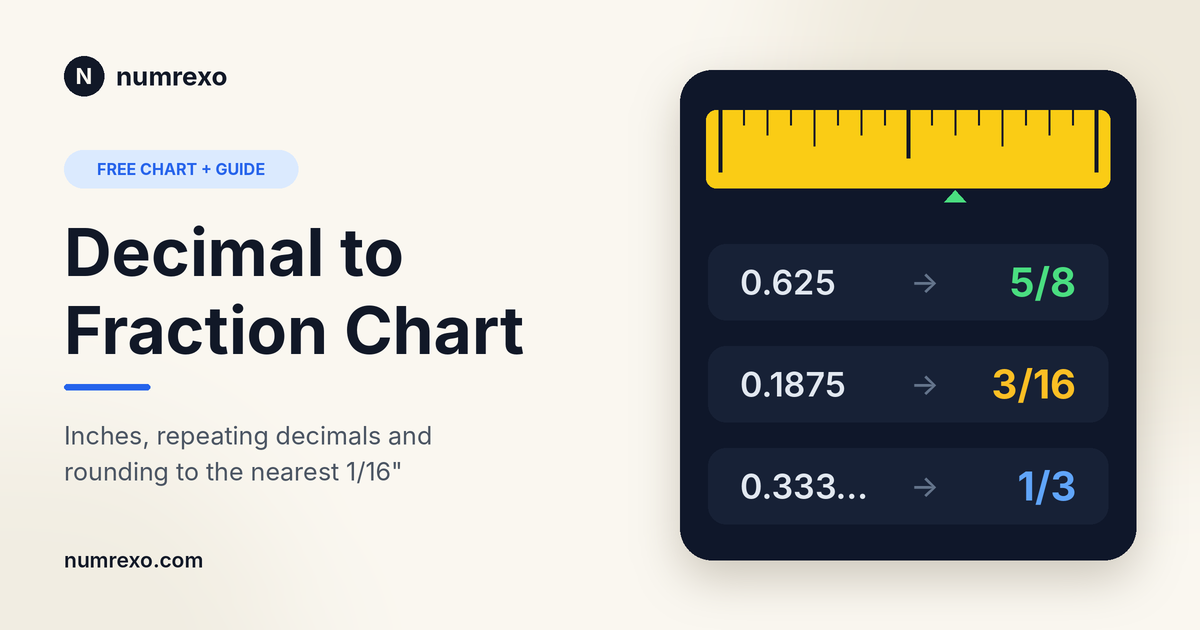
You type a measurement into a calculator and get 2.37. Your tape measure only shows 1/2, 1/4, 1/8 and 1/16 marks. A recipe converter tells you 0.67 cups, but your measuring cups say 1/3, 1/2 and 2/3. Decimals are easy for calculators. Fractions are what you need in the real world.
This guide shows you how to convert decimals to fractions by hand, with a complete decimal to fraction chart for inches, the trick for repeating decimals, and a method for rounding any decimal to the nearest 1/16 inch. When you just need the answer, the free Numrexo Decimal to Fraction Calculator converts any decimal to a fraction in lowest terms.
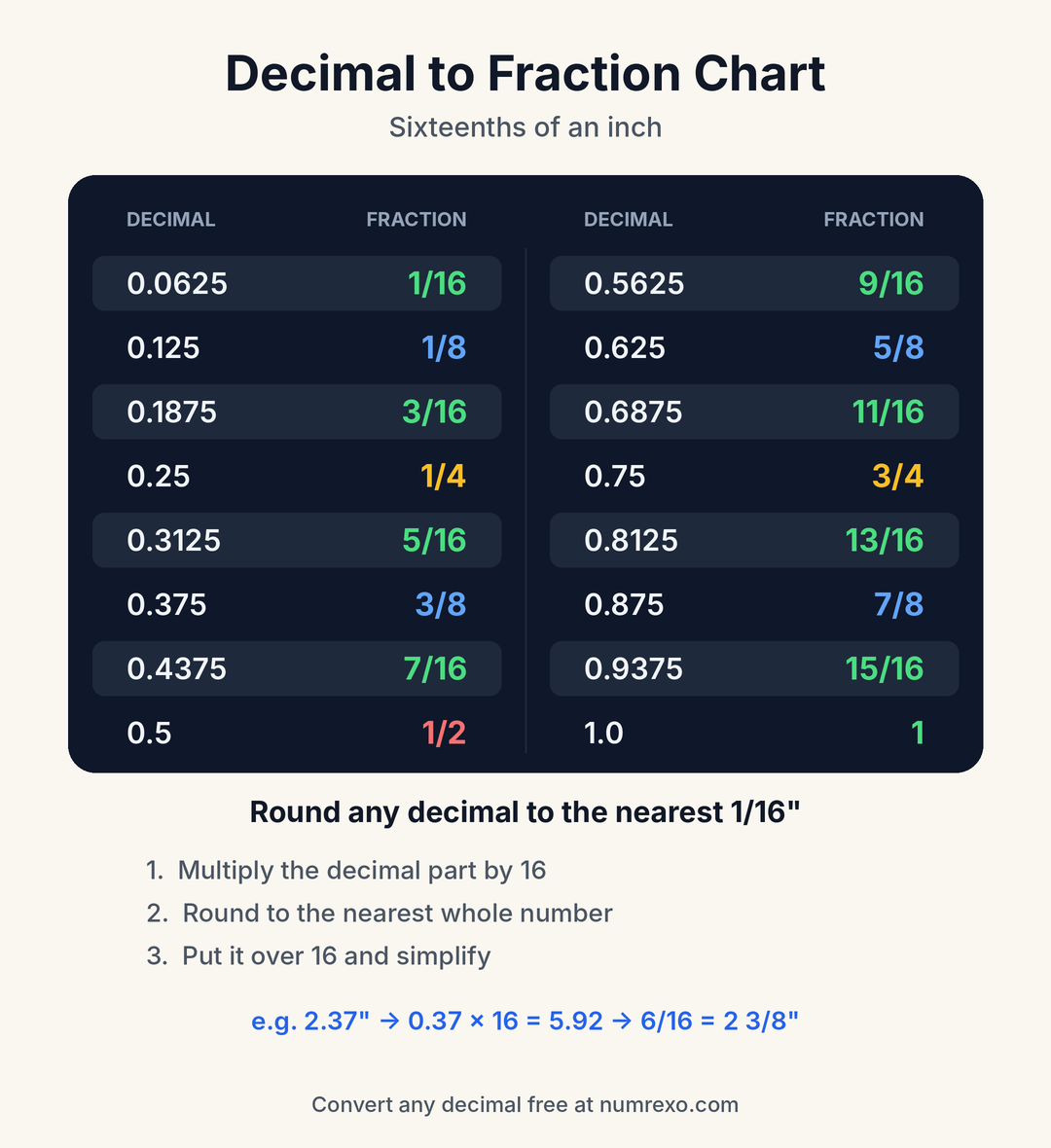
Decimal to fraction chart (sixteenths of an inch)
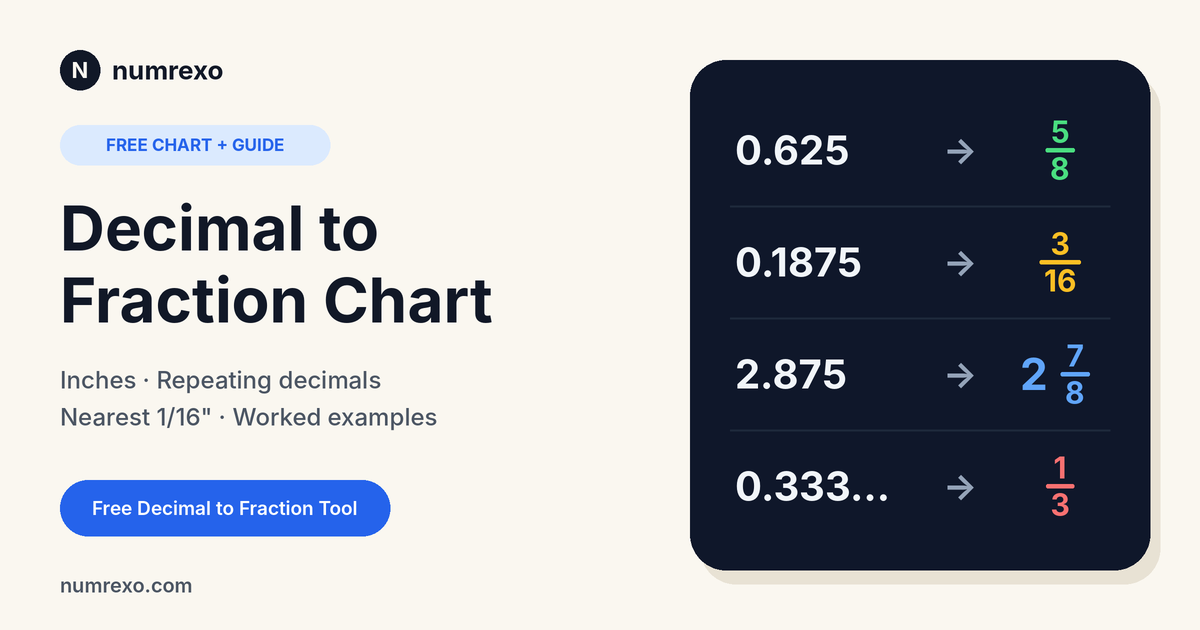
This is the chart most people are looking for. A standard US tape measure and most rulers divide each inch into 16 parts, so these are the fractions you'll actually use.
[IMAGE: decimal-to-fraction-chart.png]
| Decimal | Fraction | Decimal | Fraction |
|---|---|---|---|
| 0.0625 | 1/16 | 0.5625 | 9/16 |
| 0.125 | 1/8 | 0.625 | 5/8 |
| 0.1875 | 3/16 | 0.6875 | 11/16 |
| 0.25 | 1/4 | 0.75 | 3/4 |
| 0.3125 | 5/16 | 0.8125 | 13/16 |
| 0.375 | 3/8 | 0.875 | 7/8 |
| 0.4375 | 7/16 | 0.9375 | 15/16 |
| 0.5 | 1/2 | 1.0 | 1 |
A pattern worth remembering: every 1/16 adds 0.0625. Every 1/8 adds 0.125. Once you know that, you can rebuild the whole chart in your head.
Other common fractions
These come up in recipes, money and homework rather than on a tape measure:
| Decimal | Fraction | Where you see it |
|---|---|---|
| 0.1 | 1/10 | Tenths, 10% |
| 0.2 | 1/5 | 20% off |
| 0.333… | 1/3 | Recipes, splitting three ways |
| 0.4 | 2/5 | Test scores |
| 0.6 | 3/5 | Test scores |
| 0.666… | 2/3 | Recipes, 40 minutes of an hour |
| 0.8 | 4/5 | 80% |
| 0.1666… | 1/6 | 10 minutes of an hour |
| 0.8333… | 5/6 | 50 minutes of an hour |
How to convert a decimal to a fraction (3 steps)
This works for any decimal that ends, like 0.625 or 2.875.
- Write the decimal over 1, then move the decimal point. Count the digits after the decimal point. Multiply the top and bottom by 10 for each digit.
- Write it as a fraction with 10, 100, 1,000 and so on as the denominator.
- Simplify by dividing the top and bottom by their greatest common factor (GCF).
Example: 0.625
- Three digits after the decimal point, so use 1,000.
- 0.625 = 625/1000
- The GCF of 625 and 1,000 is 125. 625 ÷ 125 = 5, and 1000 ÷ 125 = 8, so 0.625 = 5/8
Example: 0.45
- Two digits, so use 100: 45/100
- GCF of 45 and 100 is 5
- 0.45 = 9/20
Decimals bigger than 1
Keep the whole number aside, convert the decimal part, then put them back together.
Example: 2.875
- The whole number is 2.
- 0.875 = 875/1000 = 7/8 (GCF is 125)
- So 2.875 = 2 7/8 as a mixed number, or 23/8 as an improper fraction (2 × 8 + 7 = 23).
How to convert a repeating decimal to a fraction
Repeating decimals like 0.333… or 0.272727… never end, so the "count the digits" method doesn't work. Use this algebra trick instead.
When the repeat starts right after the decimal point
Example: 0.272727… (the "27" repeats)
- Let x = 0.272727…
- The repeating block has 2 digits, so multiply by 100: 100x = 27.272727…
- Subtract the first line from the second: 100x − x = 27.2727… − 0.2727…
- 99x = 27, so x = 27/99
- Simplify (GCF 9): 0.272727… = 3/11
Shortcut: a repeating block goes over the same number of 9s. One repeating digit goes over 9, two over 99, three over 999, and so on.
- 0.444… = 4/9
- 0.272727… = 27/99 = 3/11
- 0.142857142857… = 142857/999999 = 1/7
When the repeat starts later
Example: 0.8333… (only the 3 repeats)
- Let x = 0.8333…
- Multiply by 10 to move past the non-repeating digit: 10x = 8.333…
- Multiply by 100 to move one full repeat further: 100x = 83.333…
- Subtract: 100x − 10x = 83.333… − 8.333…, so 90x = 75
- x = 75/90 = 5/6 (GCF 15)
How to round a decimal to the nearest 1/16 inch
This is the one most DIY guides skip. Calculators, plans and metric conversions often give you decimals that don't land exactly on a tape-measure mark. Here's how to find the closest one.
- Multiply the decimal part by 16.
- Round to the nearest whole number. That's your number of sixteenths.
- Simplify the fraction.
Example: 2.37 inches
- 0.37 × 16 = 5.92
- Round to 6, so you have 6/16.
- 6/16 = 3/8, so cut at 2 3/8".
2 3/8" is 2.375", only 0.005" away from 2.37". That's closer than you can mark with a pencil.
Converting millimeters to fractions of an inch
Example: 10 mm
- Convert to inches: 10 ÷ 25.4 = 0.3937"
- Nearest 1/16: 0.3937 × 16 = 6.30, round to 6, so 6/16 = 3/8" (0.375", about 0.019" short)
- Need more precision? Use 1/32 instead: 0.3937 × 32 = 12.60, round to 13, so 13/32" (0.406", about 0.013" over)
Tip: for woodworking, the nearest 1/16 is usually fine. For metalwork, drill bits or anything that has to fit tightly, go to 1/32 or 1/64.
Common mistakes to avoid
Mistake 1: Treating 0.3 or 0.33 as 1/3
- 0.3 = 3/10
- 0.33 = 33/100
- Only 0.333… (repeating forever) equals exactly 1/3.
In a recipe the difference doesn't matter. On a math test, it does.
Mistake 2: Forgetting to simplify
0.75 = 75/100 is correct but unfinished. Divide by 25 to get 3/4. Most teachers, and every tape measure, expect the simplified version.
Mistake 3: Using the wrong power of 10
0.04 has two digits after the decimal point, so it's 4/100 = 1/25, not 4/10. Count every digit, including zeros.
Mistake 4: Trusting a calculator's rounded display
If your calculator shows 0.6666667, that's 2/3 rounded off. Converting 0.6666667 as written gives you 6,666,667/10,000,000, which is technically correct but useless. When you see a long string of the same digit, it's almost always a repeating decimal.
Using the Numrexo Decimal to Fraction Calculator
- Open the Decimal to Fraction Calculator.
- Type your decimal in Enter Decimal Number, for example 0.625, 2.875 or 0.333...
- Click Convert to Fraction.
- Read the simplified fraction and the mixed number in the result.
It handles terminating decimals, repeating decimals (type them with "..." at the end) and negative numbers.
Once you have your fractions, you can add, subtract, multiply or divide them with the Fraction Calculator. To learn those steps by hand, read How to Add, Subtract, Multiply and Divide Fractions.
8 practice problems (with answers)
Convert each decimal to a fraction in lowest terms.
- 0.36
- 1.6
- 0.04
- 0.1875
- 0.222…
- 0.0505… (the "05" repeats)
- 0.8333…
- 4.3 inches, rounded to the nearest 1/16
Answers
- 9/25 (36/100, GCF 4)
- 1 3/5 (1 + 6/10 = 1 + 3/5, or 8/5)
- 1/25 (4/100, GCF 4)
- 3/16 (1875/10000, GCF 625)
- 2/9 (one repeating digit over 9)
- 5/99 (two repeating digits over 99)
- 5/6 (90x = 75, so 75/90)
- 4 5/16" (0.3 × 16 = 4.8, round to 5)
Key takeaways
- Ending decimals: put the digits over 10, 100 or 1,000, then simplify.
- Repeating decimals: put the repeating block over the same number of 9s, or use the algebra method.
- Measurements: multiply the decimal part by 16 (or 32) and round to find the nearest tape-measure mark.
- 0.3 is not 1/3. Only the repeating 0.333… is.
Have a decimal to convert right now? Use the free Decimal to Fraction Calculator and get the simplified fraction in one click.
Frequently Asked Questions
What is 0.375 as a fraction?▾
0.375 = 375/1000. The greatest common factor of 375 and 1,000 is 125, so 0.375 simplifies to 3/8. On a tape measure, that's the 3/8 inch mark.
Is 0.3 the same as 1/3?▾
No. 0.3 equals 3/10, and 0.33 equals 33/100. Only the repeating decimal 0.333… (with the 3 going on forever) is exactly 1/3.
How do I convert a decimal to the nearest 1/16 inch?▾
Multiply the decimal part by 16, round to the nearest whole number, and put it over 16. For 2.37 inches: 0.37 × 16 = 5.92, which rounds to 6, so 6/16 = 3/8. The answer is 2 3/8 inches.
What fraction of an inch is 0.1?▾
Exactly, 0.1 inch is 1/10 inch, but US tape measures don't have tenths. The nearest 1/16 mark is 1/8 inch (0.125), and the nearest 1/32 mark is 3/32 inch (0.09375), which is closer.
Why does my calculator show 0.6666667 instead of 2/3?▾
Calculators can only show a limited number of digits, so they round repeating decimals. 0.6666667 is 2/3 rounded off. When you see a long run of the same digit, treat it as a repeating decimal and convert it with the 9s method: 0.666… = 6/9 = 2/3.
How do I convert millimeters to a fraction of an inch?▾
Divide the millimeters by 25.4 to get inches, then multiply the decimal part by 16 and round. For 10 mm: 10 ÷ 25.4 = 0.3937 inch, and 0.3937 × 16 = 6.3, which rounds to 6/16 = 3/8 inch.
What is 0.875 as a fraction?▾
0.875 = 875/1000. Divide the top and bottom by 125 to get 7/8.
What is 0.6875 as a fraction?▾
0.6875 = 6875/10000. Divide the top and bottom by 625 to get 11/16. It's one of the sixteenths on a standard tape measure.
Can every decimal be written as a fraction?▾
Every decimal that ends (like 0.625) or repeats (like 0.272727…) can be written as an exact fraction. Decimals that go on forever without repeating, like pi (3.14159…), cannot. Those are called irrational numbers.
How do I convert a negative decimal to a fraction?▾
Ignore the minus sign, convert the decimal as usual, then put the minus sign back in front. For -0.75: 0.75 = 3/4, so -0.75 = -3/4.
Get new calculators & guides by email
Occasional updates when we add a new calculator or publish a useful guide. No spam, unsubscribe anytime.
By subscribing you agree to our Privacy Policy.