How to Add, Subtract, Multiply and Divide Fractions: A Step-by-Step Guide
Add, subtract, multiply and divide fractions the right way, with step-by-step examples, easy shortcuts and 10 practice problems with answers.
Sanjay Singh
Published on 24 Oct 2026 • Updated on 24 Oct 2026
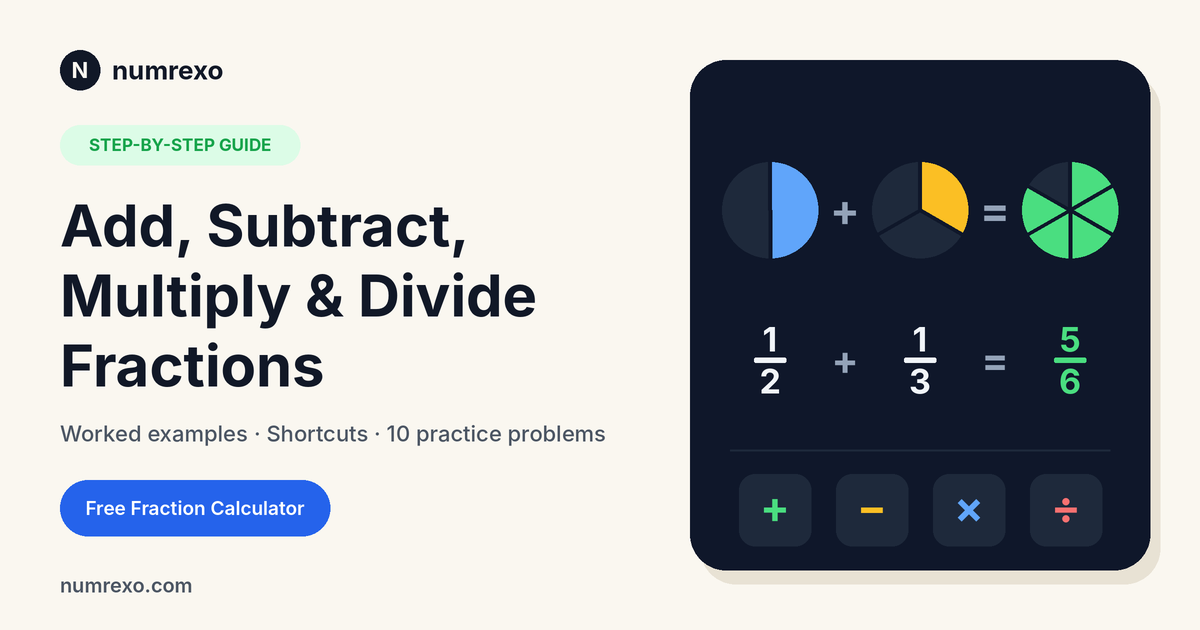
Fractions trip people up for one reason: each of the four operations follows a slightly different rule. Adding needs a common denominator. Multiplying doesn't. Dividing makes you flip something. Mix those rules up and the answer goes wrong.
This guide shows you how to add, subtract, multiply and divide fractions step by step, with fully worked examples, the shortcuts teachers use, and 10 practice problems with answers at the end. When you want to check your work, the free Numrexo Fraction Calculator shows the simplified answer and the steps.
Fraction basics in 60 seconds
A fraction has two parts:
- Numerator (top): how many pieces you have.
- Denominator (bottom): how many equal pieces make one whole.
In 3/4, the whole is cut into 4 equal pieces and you have 3 of them.
| Type | What it means | Example |
|---|---|---| | Proper fraction | Top is smaller than bottom (less than 1) | 3/4 | | Improper fraction | Top is equal to or bigger than bottom (1 or more) | 11/4 | | Mixed number | A whole number plus a proper fraction | 2 3/4 | | Equivalent fractions | Different numbers, same value | 1/2 = 2/4 = 3/6 |
Equivalent fractions are the key to everything below. Multiplying or dividing the top and bottom by the same number never changes a fraction's value. That's how we make denominators match, and how we simplify answers.
Step 0: Find the least common denominator (LCD)
You'll need this for adding and subtracting. The LCD is the smallest number that both denominators divide into evenly.
Method 1: List the multiples (best for small numbers)
For 1/4 and 1/6:
- Multiples of 4: 4, 8, 12, 16, 20…
- Multiples of 6: 6, 12, 18, 24…
- The first match is 12.
Method 2: Prime factors (best for bigger numbers)
For 5/12 and 7/18:
- 12 = 2 × 2 × 3
- 18 = 2 × 3 × 3
- Take each prime the most times it appears in either number: 2 × 2 × 3 × 3 = 36
Shortcut: If one denominator divides evenly into the other (like 4 and 8), the bigger one is the LCD. If the two denominators share no factors (like 3 and 5), multiply them: LCD = 15.
How to add fractions
When the denominators are the same
Add the numerators. Keep the denominator.
2/7 + 3/7 = 5/7
You're adding 2 sevenths and 3 sevenths, so you have 5 sevenths.
When the denominators are different
- Find the LCD.
- Rewrite each fraction with the LCD as its denominator.
- Add the numerators.
- Simplify.
Example: 5/12 + 7/18
- LCD = 36 (from the prime factor method above)
- 5/12 = (5 × 3)/(12 × 3) = 15/36, and 7/18 = (7 × 2)/(18 × 2) = 14/36
- 15/36 + 14/36 = 29/36
- 29 is prime, so this is already in lowest terms.
The most common mistake: adding straight across. 1/2 + 1/3 is not 2/5. Quick check: 2/5 is smaller than 1/2, and adding something to 1/2 can't make it smaller. The correct answer is 3/6 + 2/6 = 5/6.
Adding mixed numbers
The safest method: convert to improper fractions first.
Example: 2 3/4 + 1 5/6
- Convert: 2 3/4 = (2 × 4 + 3)/4 = 11/4, and 1 5/6 = (1 × 6 + 5)/6 = 11/6
- LCD of 4 and 6 is 12: 11/4 = 33/12, and 11/6 = 22/12
- Add: 33/12 + 22/12 = 55/12
- Convert back: 55 ÷ 12 = 4 remainder 7, so the answer is 4 7/12
Check with decimals: 2.75 + 1.833 = 4.583, and 4 7/12 = 4.583 ✓
How to subtract fractions
Subtraction follows the same steps as addition: match the denominators, then subtract the numerators.
Example: 7/8 − 1/6
- LCD of 8 and 6 is 24.
- 7/8 = 21/24, and 1/6 = 4/24
- 21/24 − 4/24 = 17/24
Subtracting mixed numbers (no borrowing headaches)
Many people learned to "borrow" from the whole number, which is easy to get wrong. Converting to improper fractions avoids borrowing completely.
Example: 5 1/4 − 2 2/3
- Convert: 5 1/4 = 21/4, and 2 2/3 = 8/3
- LCD of 4 and 3 is 12: 21/4 = 63/12, and 8/3 = 32/12
- Subtract: 63/12 − 32/12 = 31/12
- Convert back: 31 ÷ 12 = 2 remainder 7, so the answer is 2 7/12
How to multiply fractions
Good news: no common denominator needed.
- Multiply the numerators.
- Multiply the denominators.
- Simplify.
Example: 2/3 × 3/4 = 6/12 = 1/2
Shortcut: cross-cancel first
Simplify before you multiply and the numbers stay small.
Example: 4/9 × 3/8
- 4 (top) and 8 (bottom) share a factor of 4 → they become 1 and 2
- 3 (top) and 9 (bottom) share a factor of 3 → they become 1 and 3
- Now multiply: 1/3 × 1/2 = 1/6
Without cross-cancelling: 4 × 3 = 12, 9 × 8 = 72, and 12/72 = 1/6. Same answer, but more work.
Multiplying by a whole number
Write the whole number over 1.
Example: 3 × 2/5 = 3/1 × 2/5 = 6/5 = 1 1/5
Multiplying mixed numbers
Always convert first. Multiplying the whole parts and the fraction parts separately gives the wrong answer.
Example: 1 2/3 × 2 1/4
- Convert: 5/3 × 9/4
- Cross-cancel 3 and 9 → 1 and 3: 5/1 × 3/4
- Multiply: 15/4 = 3 3/4
How to divide fractions
Use "keep, change, flip":
- Keep the first fraction.
- Change ÷ to ×.
- Flip the second fraction (swap its top and bottom).
- Multiply and simplify.
Example: 3/4 ÷ 2/5
3/4 × 5/2 = 15/8 = 1 7/8
Why does flipping work?
Division asks "how many of these fit into that?" How many halves fit into 3? Six, because each whole holds two halves. So 3 ÷ 1/2 = 3 × 2 = 6. Dividing by a fraction always means multiplying by its flipped version (its reciprocal).
Dividing by a whole number
Write the whole number over 1, then flip it.
Example: 2/3 ÷ 4 = 2/3 × 1/4 = 2/12 = 1/6
Watch out: only flip the second fraction. Flipping the first one, or both, is one of the most common errors on homework.
How to simplify a fraction
A fraction is in lowest terms when the top and bottom share no common factor except 1.
- Find the greatest common factor (GCF) of the top and bottom.
- Divide both by it.
Example: 18/24
- Factors of 18: 1, 2, 3, 6, 9, 18
- Factors of 24: 1, 2, 3, 4, 6, 8, 12, 24
- GCF = 6, so 18/24 = 3/4
You can also simplify in smaller steps (18/24 → 9/12 → 3/4). Either way you get the same result.
Converting between forms
Improper fraction → mixed number: divide the top by the bottom. The answer is the whole number, and the remainder goes on top.
- 55/12 → 55 ÷ 12 = 4 remainder 7 → 4 7/12
Mixed number → improper fraction: multiply the whole number by the denominator, then add the numerator.
- 2 3/4 → (2 × 4) + 3 = 11 → 11/4
Fraction → decimal: divide the top by the bottom.
- 3/8 = 3 ÷ 8 = 0.375
- 2/3 = 0.666… (a repeating decimal)
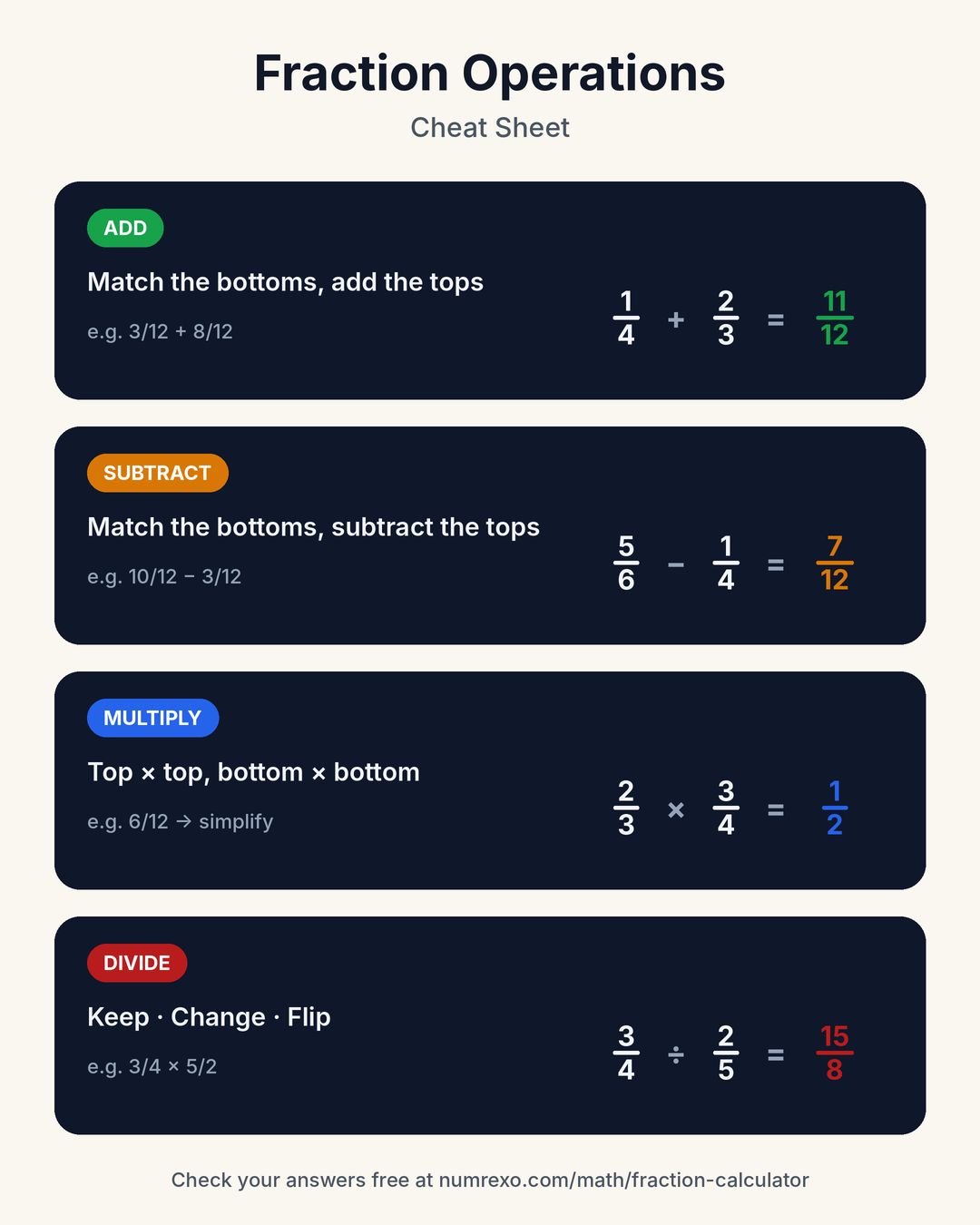
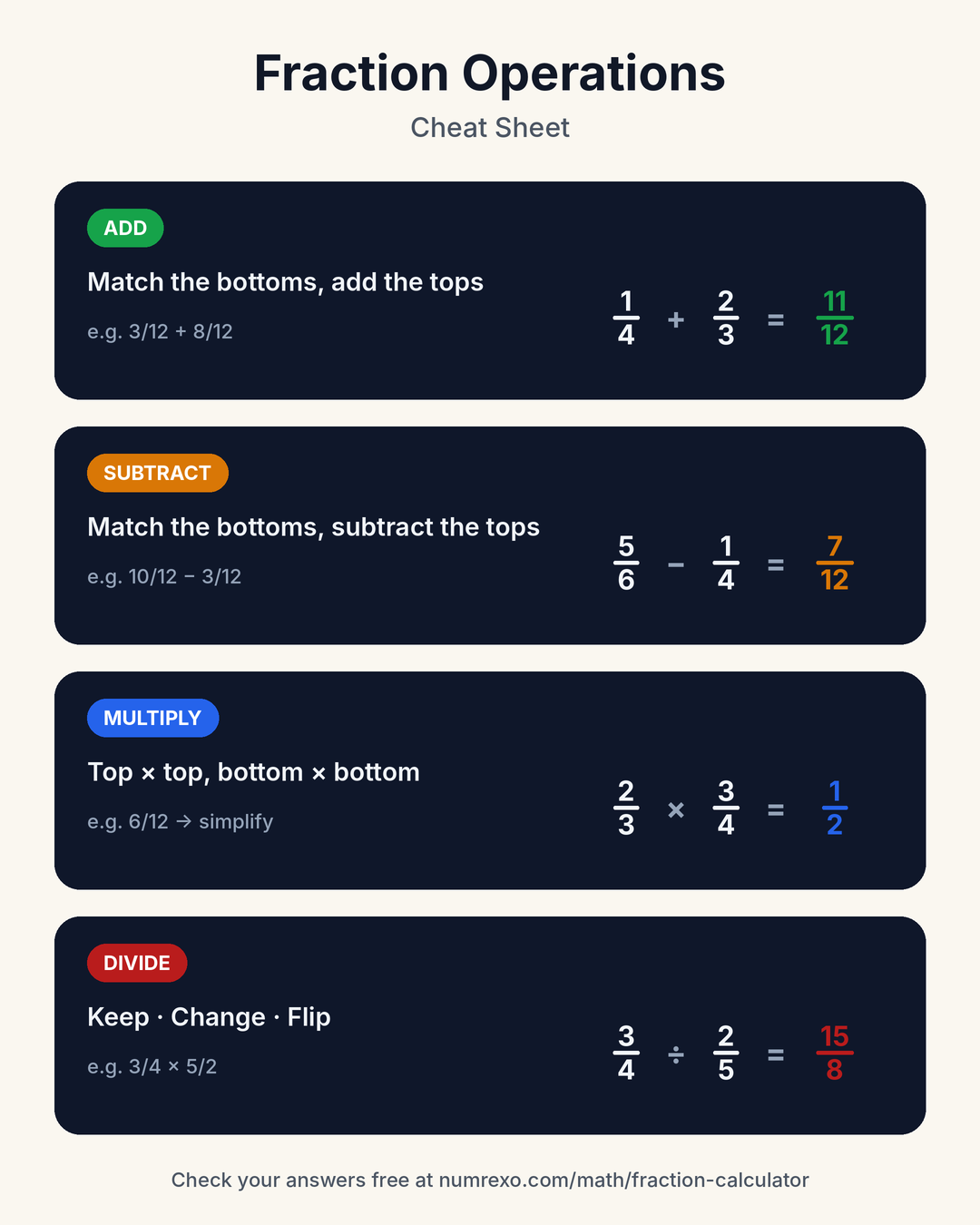
Cheat sheet: all four operations
| Operation | Common denominator? | Rule | Example |
|---|---|---|---|
| Add | Yes | Match the bottoms, add the tops | 1/4 + 2/3 = 3/12 + 8/12 = 11/12 |
| Subtract | Yes | Match the bottoms, subtract the tops | 5/6 − 1/4 = 10/12 − 3/12 = 7/12 |
| Multiply | No | Top × top, bottom × bottom | 2/5 × 15/16 = 30/80 = 3/8 |
| Divide | No | Keep, change, flip | 3/4 ÷ 2/5 = 3/4 × 5/2 = 15/8 |
Using the Numrexo Fraction Calculator
Once you know the method, a calculator is the fastest way to check your work, or to get through a long worksheet.
- Open the Fraction Calculator.
- Enter the First Fraction (numerator and denominator).
- Pick the operation: Add, Subtract, Multiply or Divide.
- Enter the Second Fraction.
- Click Calculate.
You get the answer in lowest terms, as a mixed number and as a decimal, along with the steps. For students, the steps are the useful part: compare them with your own working to find exactly where an answer went off track.
Tip for mixed numbers: convert them to improper fractions before entering. For 2 3/4, enter 11 as the numerator and 4 as the denominator.
10 practice problems (with answers)
Try these on paper first, then check them with the calculator.
- 2/7 + 3/7
- 1/4 + 2/3
- 5/6 − 1/4
- 3 1/2 − 1 3/4
- 2/5 × 15/16
- 6 × 3/4
- 7/10 ÷ 7/20
- 1 1/3 ÷ 2/9
- Simplify 45/60
- Which is bigger: 5/8 or 7/12?
Answers
- 5/7 (same denominator, so add the tops)
- 11/12 (3/12 + 8/12)
- 7/12 (10/12 − 3/12)
- 1 3/4 (7/2 − 7/4 = 14/4 − 7/4 = 7/4)
- 3/8 (cross-cancel: 2/1 × 3/16 = 6/16 = 3/8)
- 4 1/2 (6/1 × 3/4 = 18/4 = 9/2)
- 2 (7/10 × 20/7 = 140/70 = 2)
- 6 (4/3 × 9/2 = 36/6 = 6)
- 3/4 (GCF of 45 and 60 is 15)
- 5/8 (cross-multiply: 5 × 12 = 60 and 7 × 8 = 56, and 60 > 56)
Key takeaways
- Add and subtract: find the LCD first, then work with the numerators only.
- Multiply: straight across. Cross-cancel first to keep the numbers small.
- Divide: keep, change, flip. Only the second fraction gets flipped.
- Mixed numbers: convert them to improper fractions before doing anything else.
- Always simplify and check your answer as a decimal.
Ready to check your work? Open the free Fraction Calculator, enter your two fractions, and see every step.
Frequently Asked Questions
What is the least common denominator (LCD)?▾
It is the smallest number that both denominators divide into evenly. For 1/4 and 1/6, the LCD is 12, because 12 is the smallest number that both 4 and 6 go into.
Do you need a common denominator to multiply or divide fractions?▾
No. Common denominators are only needed for adding and subtracting. To multiply, multiply the tops and the bottoms. To divide fractions, flip the second fraction and multiply.
Why do you flip the second fraction when you divide fractions?▾
Dividing asks "how many of these fit?" Dividing by 1/2 asks how many halves fit, and there are always twice as many halves as wholes. So dividing by 1/2 is the same as multiplying by 2/1. The same idea works for every fraction.
What is cross-cancelling?▾
It is simplifying before you multiply. In 4/9 × 3/8, divide 4 and 8 by 4, and 3 and 9 by 3. You get 1/3 × 1/2 = 1/6, with smaller numbers and no simplifying at the end.
How can I check if my fraction answer is right?▾
Convert each fraction to a decimal and do the same calculation. For 2 3/4 + 1 5/6 = 4 7/12, check it: 2.75 + 1.833 = 4.583, and 4 7/12 = 4.583. You can also enter the problem into the Numrexo Fraction Calculator to see each step.
How do I add three fractions at once?▾
Find one common denominator for all three, then add the numerators. For 1/2 + 1/3 + 1/4, the LCD is 12: 6/12 + 4/12 + 3/12 = 13/12 = 1 1/12. In the Numrexo Fraction Calculator, add the first two fractions, then add the third fraction to that result.
Why does multiplying fractions give a smaller number?▾
Multiplying by a fraction less than 1 means taking a part of something. 3/4 × 1/2 means "half of 3/4", which is 3/8, so the answer is smaller than 3/4. Multiplying by a fraction greater than 1, like 3/2, makes the number bigger.
What is the difference between LCD and GCF?▾
The LCD (least common denominator) is the smallest number both denominators divide into, and you use it to add or subtract fractions. The GCF (greatest common factor) is the biggest number that divides both the top and bottom of one fraction, and you use it to simplify. For 4 and 6, the LCD is 12 and the GCF is 2.
Do I always have to simplify my answer?▾
In most homework and tests, yes. Answers are expected in lowest terms, so 6/12 should be written as 1/2. Simplifying also makes the answer easier to read and compare. The Numrexo Fraction Calculator shows every answer in lowest terms automatically.
Is it easier to use decimals instead of fractions?▾
Decimals work well for fractions like 1/2 (0.5) or 3/8 (0.375). But many fractions, like 1/3 (0.333…), turn into repeating decimals, so rounding them makes the answer slightly wrong. Keep fractions for exact answers and use decimals only to check your result.
Get new calculators & guides by email
Occasional updates when we add a new calculator or publish a useful guide. No spam, unsubscribe anytime.
By subscribing you agree to our Privacy Policy.