EMI Calculator: Calculate Your Monthly Loan Payment for a Car, Home, Land, Bike & More
Sanjay Singh
Published on 19 Aug 2026 • Updated on 30 Sept 2026
When you borrow money, the number that usually gets your attention is the monthly payment.
A $600 car payment sounds manageable.
A $2,500 mortgage payment might fit your budget.
A $350 motorcycle payment may seem easy to handle.
But there is a problem with looking at the monthly payment alone:
A lower monthly payment does not necessarily mean a cheaper loan.
The loan term, interest rate, APR, amount borrowed, down payment, fees, and other costs can dramatically change what you ultimately pay.
That's where an EMI calculator—or, in the terminology more commonly used in the United States, a loan payment calculator—becomes useful.
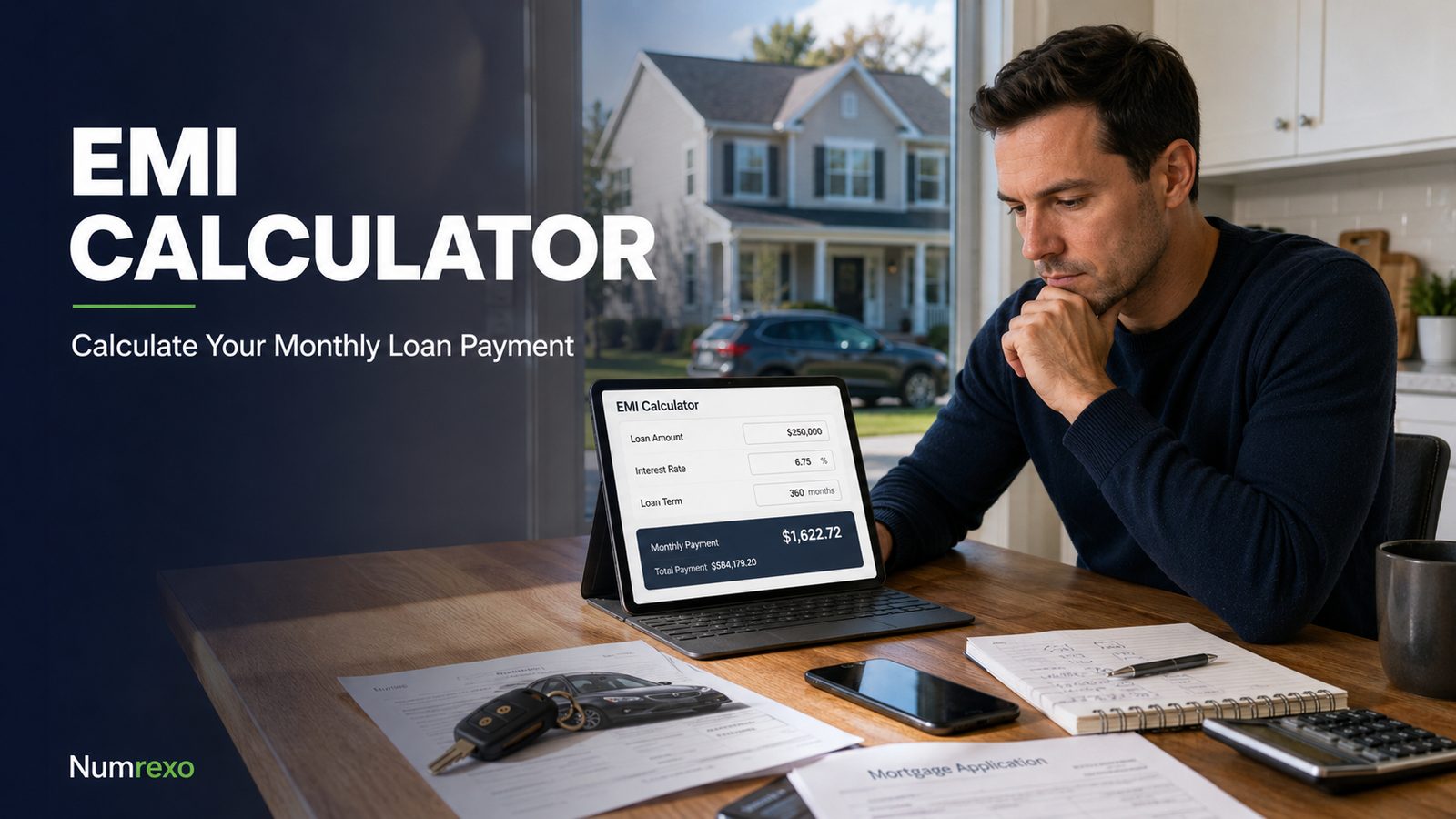
With Numrexo's EMI Calculator, you can enter a loan amount, annual interest rate, loan term, and optional prepayment amount to estimate the payment and understand how the loan behaves over time.
Whether you're financing a car, motorcycle, house, land, personal expense, education, or another major purchase, calculating the payment before you borrow can help you make a more informed decision.
Key Takeaways
- EMI stands for Equated Monthly Installment and represents a recurring loan payment.
- In the U.S., people are more likely to search for terms such as monthly loan payment, loan payment calculator, car payment calculator, or mortgage payment calculator.
- Your payment is primarily influenced by the amount borrowed, interest rate, and loan term.
- A longer loan term can reduce the monthly payment but increase the total interest paid.
- APR is important because it can include certain borrowing costs beyond the stated interest rate.
- A down payment reduces the amount you need to finance.
- Extra payments can potentially reduce interest and shorten the repayment period, depending on the loan terms.
- Your calculated payment is an estimate; the actual payment can differ because of taxes, insurance, lender fees, and other costs.
- Comparing loans by total cost, not just monthly payment, is essential.
What Is an EMI?
EMI stands for Equated Monthly Installment.
It is a fixed or scheduled payment made toward an amortizing loan. Each payment generally contains two components:
- Principal — the amount you borrowed.
- Interest — the cost of borrowing the money.
As you make payments, the outstanding principal typically decreases. Because interest is calculated based on the remaining balance, the amount of each payment allocated to interest generally changes over the life of the loan.
In the United States, the term "EMI" is less common than "monthly payment."
For example, an American borrower might search for:
- Car payment calculator
- Auto loan calculator
- Monthly loan payment calculator
- Mortgage payment calculator
- Personal loan calculator
- Motorcycle loan calculator
- Land loan calculator
They are generally trying to answer the same basic question:
"How much will I have to pay each month?"
Try the Numrexo EMI Calculator
Before committing to a loan, run the numbers yourself.
Enter:
- Loan amount
- Annual interest rate
- Loan term
- Optional prepayment
The Numrexo EMI Calculator uses the standard amortization formula to estimate the recurring payment.
For U.S. borrowers, remember that the calculator result should be treated as a loan-payment estimate, not a lender quote.
How Does an EMI Calculator Work?
A standard amortizing loan payment can be calculated using this formula:
EMI = P × r × (1 + r)ⁿ ÷ [(1 + r)ⁿ − 1]
Where:
- P = principal or original loan amount
- r = monthly interest rate
- n = total number of monthly payments
If a lender quotes an annual interest rate, the monthly rate is commonly derived by dividing the annual rate by 12.
For example, suppose you borrow:
$30,000
at:
7% annual interest
for:
60 months
The calculator can estimate the monthly principal-and-interest payment.
The important point is that the calculation does not simply divide $30,000 by 60.
Interest must also be paid.
That difference is why understanding amortization matters.
What Actually Determines Your Monthly Loan Payment?
Three variables have the biggest direct impact on a standard amortizing loan payment:
1. Loan Amount
The more money you borrow, the higher the payment generally becomes.
Borrowing $20,000 and borrowing $40,000 at the same rate and term will not produce the same monthly payment.
2. Interest Rate
A higher interest rate increases the cost of borrowing.
This is particularly important when borrowing large amounts over many years.
3. Loan Term
The term is how long you have to repay the loan.
A longer term usually lowers the required monthly payment because the balance is spread across more payments.
But there is a catch.
You may pay substantially more interest over the entire loan.
The Consumer Financial Protection Bureau specifically recommends comparing the APR, interest rate, loan length, amount financed, and monthly payment rather than focusing only on the monthly payment.
Why a Lower Monthly Payment Can Cost You More
Imagine two borrowers financing the same amount.
One chooses a shorter repayment period.
The other chooses a longer repayment period.
The second borrower may enjoy a smaller monthly payment.
That sounds attractive.
But the loan remains outstanding for longer, meaning interest has more time to accumulate.
This is one of the most common mistakes people make when comparing financing options.
Think about loans in two dimensions:
Monthly affordability
and
Total borrowing cost
You need both.
A payment that fits comfortably into your budget is important.
But so is the total amount you will pay by the time the loan reaches zero.
Car Loan EMI Calculator: How Much Will Your Car Payment Be?
For many Americans, an auto loan is one of the most common forms of installment debt.
The amount you finance can depend on:
- Vehicle price
- Down payment
- Trade-in value
- Sales tax
- Dealer fees
- Loan term
- Interest rate or APR
- Optional products added to the loan
The Federal Reserve Bank of New York reported that U.S. auto loan balances reached record levels in 2026, while the Federal Reserve has also noted that auto-loan delinquencies remain elevated compared with much of the previous decade.
That makes understanding the cost of an auto loan more important than simply asking:
"Can I afford this car payment?"
The better question is:
"Can I comfortably afford the entire cost of financing this vehicle?"
Example: Calculating a $30,000 Car Loan
Suppose you finance:
Loan amount: $30,000
Interest rate: 7%
Term: 60 months
Your estimated principal-and-interest payment would be approximately:
$594 per month
Over 60 payments, you would pay roughly:
$35,600
That means approximately:
$5,600 in interest
The exact amount can vary depending on the loan structure, fees, and lender terms.
Now imagine extending the loan to 72 months.
The monthly payment would decrease.
But the total interest would increase.
This is exactly why a loan calculator should show more than one number.
Auto Loans in the U.S. Are Getting More Expensive to Ignore
Recent U.S. data illustrates why monthly payment planning matters.
According to 2026 data reported from the Federal Reserve Bank of New York, auto loan originations reached approximately $211 billion in the spring quarter.
At the same time, average vehicle financing costs remain significant.
Experian reported an average used-car interest rate of 11.43% in Q1 2026, although actual rates vary substantially based on credit score, lender, vehicle, term, and other factors.
The lesson isn't that you should avoid financing.
It is that you should calculate before you negotiate.
Motorcycle or Bike Loan Payment Calculator
In the U.S., motorcycles are commonly financed through motorcycle or powersports loans rather than the "bike EMI" terminology used in some other countries.
The calculation principle is similar.
Suppose you finance:
$12,000
at:
8%
for:
48 months
The estimated monthly principal-and-interest payment would be around:
$293
But don't stop there.
Your real ownership cost could also include:
- Insurance
- Registration
- Maintenance
- Fuel
- Gear
- Dealer fees
- Taxes
A motorcycle loan that looks affordable on a monthly basis can become considerably more expensive once the complete ownership budget is considered.
Home Loan EMI: Understanding Mortgage Payments
For a house, the U.S. terminology is generally mortgage payment, not EMI.
Mortgage payments can be more complicated than standard consumer loan payments.
A mortgage payment may include:
- Principal
- Interest
- Property taxes
- Homeowners insurance
- Mortgage insurance
- HOA-related costs in some situations
This is why the principal-and-interest figure from a basic loan calculator may not equal the amount that actually leaves your bank account each month.
For example, a mortgage payment might look like:
Principal + Interest + Taxes + Insurance + Other applicable costs
So when comparing homes, don't use the loan payment alone as your affordability test.
What Are Mortgage Rates Doing in 2026?
Mortgage rates have remained an important affordability issue for American homebuyers.
Freddie Mac's Primary Mortgage Market Survey reported a 6.66% average 30-year fixed mortgage rate on July 30, 2026, while the 15-year fixed rate averaged 6.04%.
Rates move over time, and the rate available to an individual borrower can differ from the national average.
Your credit profile, loan type, down payment, property, lender, and market conditions can all matter.
That is why your personal mortgage quote—not a national average—is what ultimately determines your payment.
Land Loan Payment Calculator: Financing Land Is Different
Buying land is another situation where a monthly loan-payment calculation can be useful.
Land financing can include:
- Raw land
- Unimproved land
- Residential lots
- Agricultural land
- Recreational property
However, land loans are not necessarily priced or structured like conventional mortgages.
Some lenders may require:
- Larger down payments
- Shorter repayment periods
- Different interest rates
- Additional documentation
- Specific property requirements
If you're considering land financing, calculate the payment before making an offer.
But also verify the lender's complete terms.
Personal Loan Payment Calculator
Personal loans are commonly used for:
- Debt consolidation
- Home improvement
- Large purchases
- Moving expenses
- Education expenses
- Unexpected expenses
Personal loans can have very different rates depending on the borrower and lender.
A $10,000 personal loan at 8% is a very different financial proposition from a $10,000 loan at 25%.
The monthly payment alone doesn't tell the whole story.
Always compare:
APR + monthly payment + term + total repayment
What Is APR and Why Does It Matter?
APR stands for Annual Percentage Rate.
It is designed to provide a broader measure of borrowing cost than the interest rate alone because it can incorporate certain fees associated with obtaining credit.
This distinction matters.
A loan advertised at a low interest rate is not automatically the cheapest loan.
Two lenders might offer similar interest rates but different fees.
The APR can help you make a more meaningful comparison.
For U.S. borrowers, the Consumer Financial Protection Bureau recommends considering APR, interest rate, loan term, amount financed, and monthly payment when comparing auto loans.
Interest Rate vs APR: What's the Difference?
Think of it this way:
Interest Rate
Primarily represents the rate charged on the borrowed principal.
APR
Provides a broader representation of the annual borrowing cost and may incorporate certain fees.
Therefore:
Interest rate ≠ APR
When comparing loan offers, look at both.
How a Down Payment Changes Your Loan
A down payment reduces the amount you need to borrow.
Suppose a vehicle costs:
$40,000
You make a:
$8,000 down payment
Your starting financed amount may be approximately:
$32,000
before applicable taxes, fees, trade-in adjustments, and other financing details.
A smaller principal generally means a smaller payment and less interest, assuming the remaining loan terms are unchanged.
A larger down payment can therefore improve affordability.
But don't drain your emergency savings simply to make a larger down payment.
The correct amount depends on your overall financial position.
Does a Longer Loan Term Always Make Sense?
No.
This is one of the most important decisions to understand before borrowing.
A longer term can:
- Reduce the monthly payment
- Increase total interest
- Keep you in debt longer
- Increase the risk of owing more than an asset is worth in some situations
The CFPB warns consumers that focusing only on the monthly payment can obscure the total cost of an auto loan.
A better comparison looks like this:
| Loan Term | Monthly Payment | Total Interest | Debt-Free Date |
|---|---|---|---|
| Shorter | Higher | Usually lower | Earlier |
| Longer | Lower | Usually higher | Later |
The "best" term is not automatically the shortest or longest.
It is the term that balances affordability with a reasonable total borrowing cost.
What Is Amortization?
Amortization is the process of paying down a loan through scheduled payments.
At the beginning of many amortizing loans, a larger share of each payment goes toward interest.
As the principal balance declines, the interest portion generally decreases and more of the payment goes toward principal.
This is why two loans with identical monthly payments can have very different remaining balances depending on their interest rate and repayment schedule.
Understanding amortization helps answer a much more useful question:
"How much of my payment is actually reducing my debt?"
How Extra Payments Can Save Interest
Making additional payments toward principal can reduce the outstanding balance faster.
That can potentially:
- Reduce total interest
- Shorten the repayment period
- Help you become debt-free sooner
But there is an important condition:
Check your loan agreement first.
Some loans have specific rules around prepayments, and the financial effect depends on how the lender applies additional payments.
Numrexo's EMI Calculator includes an optional prepayment field specifically so users can explore how additional payments may affect the loan.
How Much Loan Can You Actually Afford?
This is where many borrowers make a mistake.
They calculate the maximum payment a lender might approve.
But approval and affordability are not the same thing.
Before taking a loan, consider:
- Housing costs
- Utilities
- Insurance
- Food
- Transportation
- Existing debt
- Emergency savings
- Retirement contributions
- Childcare
- Taxes
- Maintenance
- Unexpected expenses
Then ask:
"Would I still be comfortable making this payment if one of my expenses increased?"
A loan should fit your financial life—not consume it.
The 5 Numbers You Should Calculate Before Taking a Loan
Before signing, know these five numbers:
1. Amount Financed
How much are you actually borrowing?
2. Interest Rate
What rate is being charged?
3. APR
What is the broader annual cost of credit?
4. Monthly Payment
How much will you owe each payment period?
5. Total Amount Paid
How much will you pay by the end of the loan?
If someone only tells you:
"Your payment will be $599 a month."
you still don't know enough.
Ask for the complete financing picture.
EMI vs Monthly Loan Payment: Are They the Same?
For most practical purposes, they refer to a similar concept: the recurring payment required to repay an installment loan.
The difference is primarily terminology.
EMI is widely used in countries such as India and other international markets.
Monthly payment or loan payment is more common in the United States.
For Numrexo, this distinction matters because users searching Google in the U.S. may search for "loan payment calculator" even if they would understand the concept of EMI.
Common Loan Calculation Mistakes
Mistake 1: Looking Only at the Monthly Payment
A $500 payment isn't necessarily cheaper than a $600 payment.
You need to know the loan term and total repayment.
Mistake 2: Ignoring APR
Fees can change the real cost of borrowing.
Mistake 3: Choosing the Longest Term Automatically
A longer term can reduce monthly pressure but increase total interest.
Mistake 4: Forgetting Taxes and Insurance
Especially with vehicles and property.
Mistake 5: Borrowing Based on the Maximum Approval
A lender's maximum isn't necessarily your comfortable budget.
Mistake 6: Forgetting the Down Payment
The amount you finance can be substantially different from the sticker price.
Mistake 7: Not Comparing Multiple Offers
Even a small difference in rate can matter when the balance is large or the term is long.
How to Use the Numrexo EMI Calculator
Using the calculator is straightforward.
Step 1: Enter the Loan Amount
Enter the amount you plan to finance.
Step 2: Enter the Annual Interest Rate
Use the rate offered by the lender.
Step 3: Enter the Loan Term
Enter how long you expect to take to repay the loan.
Step 4: Add a Prepayment Amount
If you are planning additional payments, enter the amount to explore the potential impact.
Step 5: Calculate
The calculator estimates the monthly payment and helps you understand the interest and repayment structure.
For a real loan, compare the calculator estimate with the lender's official disclosure before making a decision.
Frequently Asked Questions
What is an EMI calculator?
An EMI calculator estimates the recurring payment required to repay an amortizing loan based on the principal, interest rate, and repayment period.
In the U.S., similar tools are commonly called loan payment calculators or monthly payment calculators.
How is EMI calculated?
A standard amortizing payment can be calculated using the principal, periodic interest rate, and number of payments.
The formula is:
EMI = P × r × (1+r)ⁿ / ((1+r)ⁿ − 1)
Can I use an EMI calculator for a car loan?
Yes. You can use an amortization-based loan calculator to estimate an auto loan payment.
However, taxes, fees, trade-in values, warranties, insurance, and other costs may not be included in the basic calculation.
Can I calculate a mortgage payment with an EMI calculator?
You can estimate the principal-and-interest portion of a mortgage payment using an amortization calculator.
However, a complete U.S. mortgage payment can also include property taxes, homeowners insurance, mortgage insurance, HOA expenses, and other costs.
Can I calculate a motorcycle loan?
Yes. A motorcycle or powersports loan can generally be estimated using the same basic amortization approach.
Can I calculate a land loan?
You can estimate payments if the land loan uses a standard amortizing structure.
However, land loans can have different terms and requirements from conventional mortgages.
Does a longer loan term reduce EMI?
Usually, yes.
But you will generally make more payments and may pay more interest over the entire loan.
Does a higher down payment reduce monthly payments?
Generally, yes, because you borrow less.
Can extra payments reduce interest?
They can, depending on the loan terms and how the lender applies additional payments toward principal.
Is the Numrexo EMI calculation the same as my lender's payment?
Not necessarily.
A calculator provides an estimate based on the numbers entered. Your actual payment may differ because of lender-specific terms, fees, taxes, insurance, APR structure, or other costs.
Final Thoughts: Calculate Before You Commit
A loan payment can look deceptively simple.
"$600 per month."
But behind that number are three questions that matter much more:
How much am I borrowing?
How much will I pay in interest?
How much will this loan cost me in total?
Whether you're financing a car, motorcycle, house, land, education, or personal expense, calculating the payment before you sign can give you a clearer picture of what you're actually committing to.
Use a calculator to explore different combinations of loan amount, interest rate, term, and prepayment.
Then compare the results with real lender offers.
The goal isn't simply to find the smallest monthly payment.
The goal is to find financing that you can afford—and understand exactly what it will cost you.
Sources & Research Basis
This article uses U.S. financial and consumer-credit data and guidance from authoritative sources including the Federal Reserve, Federal Reserve Bank of New York, Consumer Financial Protection Bureau, Freddie Mac, and Experian.
Important 2026 data points should be treated as time-sensitive because interest rates, loan rates, and credit-market conditions change.
Financial disclaimer: Numrexo calculators provide estimates for informational and educational purposes. They are not loan approvals, financial advice, or lender quotes. Actual loan payments depend on lender-specific terms, APR, fees, taxes, insurance, credit profile, and other factors.
Get new calculators & guides by email
Occasional updates when we add a new calculator or publish a useful guide. No spam, unsubscribe anytime.
By subscribing you agree to our Privacy Policy.