How to Calculate Flight Time: Formula, Examples and What Changes It
A simple formula gets you within minutes of most airline schedules. Here's how to calculate flight time, why the same route is faster one way, and how to work out your local arrival time.
Sanjay Singh
Published on 15 Oct 2026 • Updated on 15 Oct 2026
## You've found a flight, but the booking page shows a duration that seems oddly long, or a return leg that's an hour slower than the way out. Or maybe you're flying private, comparing routes, or planning a tight connection and want to know how long you'll actually be in the air.
The good news: flight time follows a simple formula. Once you know it, and the handful of things that bend it, you can estimate almost any trip within a few minutes of the airline's own schedule.
The quick answer
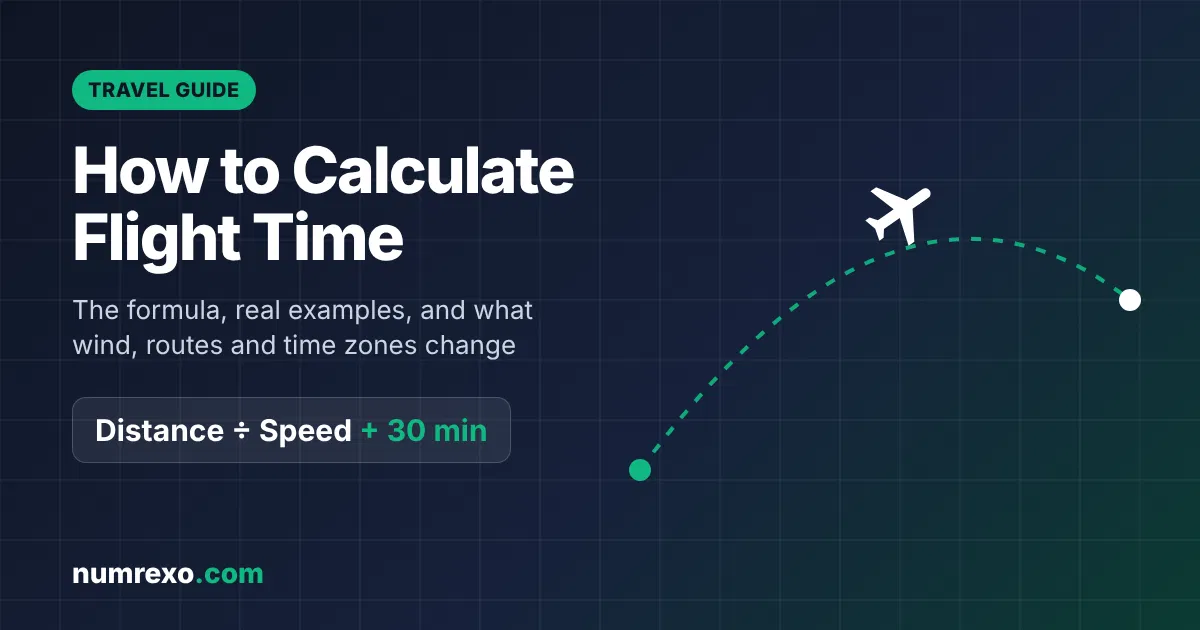
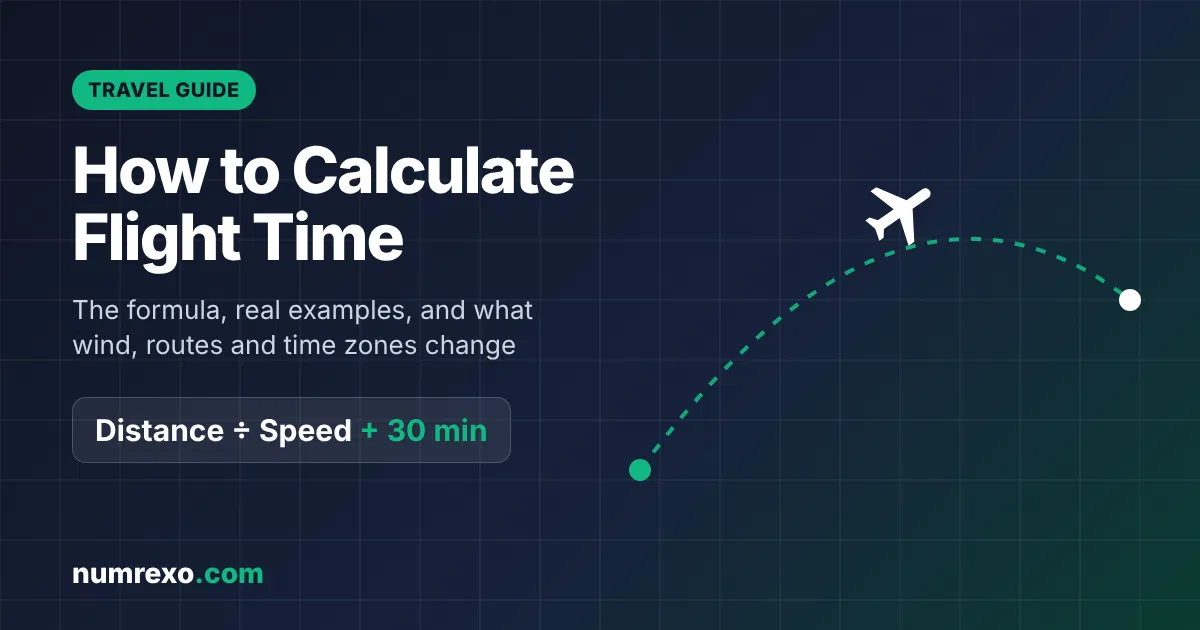
Flight time ≈ Distance ÷ Cruising speed + about 30 minutes
Distance is the straight "great-circle" distance between the two airports. Cruising speed for most passenger jets is around 500–575 mph (about 800–925 km/h). The extra 30 minutes covers taxiing, takeoff, climb, descent and landing, when the plane is moving much slower than cruise speed.
That's the core of it. The rest of this guide shows you how to apply it, and why real-world times sometimes land on either side of your estimate.
[IMAGE: flight-time-formula-example.png | Alt: Flight time formula worked example, New York to London: 3,451 miles divided by 550 mph plus 30 minutes equals about 6 hours 46 minutes]
Step by step: how to calculate flight time Step 1: Find the distance
Use the great-circle distance between the two airports. This is the shortest path over the curved surface of the Earth. It's why flights from the US to Asia arc up toward Alaska instead of following a straight line on a flat map.
Airlines don't always fly the exact great-circle line (more on that below), but it's the right starting point.
Step 2: Pick a cruising speed
Different aircraft cruise at slightly different speeds. These are typical averages:
Aircraft Typical cruise speed (mph) (km/h) Common use Embraer E175 520 835 Short regional routes Airbus A320 540 870 Domestic and short international Boeing 737 550 885 Domestic and short international Airbus A380 560 900 Long-haul, high-capacity Boeing 777 575 925 Long-haul Average commercial jet 550 885 Good default if you're unsure
If you don't know the aircraft, 550 mph (885 km/h) is a sensible default.
Step 3: Divide distance by speed
This gives you the time spent cruising, in hours. To turn the decimal into minutes, multiply the part after the decimal point by 60.
For example, 1.62 hours = 1 hour + (0.62 × 60) minutes = 1 hour 37 minutes.
Step 4: Add time for takeoff, landing and taxi
Add around 30 minutes. At busy hub airports, long taxi routes and holding patterns can push this to 45 minutes or more. At small regional airports it can be less.
Three worked examples Example 1: Chicago (ORD) to Denver (DEN) Distance: about 888 miles Aircraft: Boeing 737 at 550 mph 888 ÷ 550 = 1.61 hours = 1 hour 37 minutes Add 30 minutes = about 2 hours 7 minutes
Airline schedules for this route are typically a little longer, because they print block time (gate to gate), which includes extra buffer. More on that below.
Example 2: New York (JFK) to London (LHR) Distance: about 3,451 miles Aircraft: average jet at 550 mph 3,451 ÷ 550 = 6.27 hours = 6 hours 16 minutes Add 30 minutes = about 6 hours 46 minutes
That's very close to typical eastbound schedules on this route. The return trip, London to New York, is usually scheduled roughly an hour longer. The distance is identical, so why? The answer is wind.
Example 3: London (LHR) to Rome (FCO), in kilometers Distance: about 1,445 km Aircraft: Airbus A320 at 870 km/h 1,445 ÷ 870 = 1.66 hours = 1 hour 40 minutes Add 30 minutes = about 2 hours 10 minutes
The formula works the same way in kilometers. Just keep your distance and speed in matching units.
Why the same route is faster one way: the jet stream
High above the North Atlantic and much of the Northern Hemisphere, fast bands of wind called jet streams generally blow from west to east. Their core can reach well over 100 mph.
Flying east (e.g., New York → London), planes can ride the jet stream as a tailwind, which raises their ground speed and shortens the trip. Flying west (e.g., London → New York), the same wind becomes a headwind, which slows the plane relative to the ground and adds time.
As a rough guide, headwinds can add around 5–15% to flight time, and tailwinds can cut 5–10%. Airlines plan routes each day to make the most of the winds, which is why the exact path of your flight can change from one day to the next.
[IMAGE: jet-stream-eastbound-vs-westbound.png | Alt: Diagram showing eastbound flights get a tailwind from the jet stream while westbound flights face a headwind and take longer]
Practical tip: if your estimate is for a westbound long-haul flight across the Atlantic or Pacific, add 10–15% to be safe.
Why your ticket shows a different time: air time vs. block time
Three different "times" get mixed up all the time:
Air time is the time from takeoff to touchdown. This is what the basic formula estimates (before you add the extra 30 minutes). Block time is the time from when the plane pushes back from the gate to when it parks at the destination gate. This is what airlines schedule and print on your booking. It includes taxiing and a buffer for delays. The clock gap on your ticket is the local arrival time minus the local departure time. Because it mixes two time zones, it can look much longer or shorter than the real flight.
[IMAGE: air-time-vs-block-time.png | Alt: Table comparing air time, block time and the ticket clock gap for flights]
Airlines often build extra minutes into block time so that more flights arrive "on time." That's why you sometimes land early even when nothing seemed to go faster.
Other factors that change flight duration
Routing and airspace. Planes follow set air routes, avoid restricted airspace, and get rerouted around storms. Any detour adds distance.
Air traffic. Busy airspace and holding patterns near major hubs can add 10–30 minutes.
Airport congestion. Long taxi queues at large airports can add another 15–30 minutes on the ground.
Aircraft weight and altitude. Heavily loaded long-haul flights may climb in stages and cruise lower at first, which affects speed and fuel use.
Weather. Thunderstorms, strong crosswinds and de-icing in winter can all add time before and during the flight.
None of these are under your control, but knowing them helps you plan buffers for connections and pickups.
How to work out your local arrival time
This is where many travelers get tripped up. Here's a simple method:
Take your departure time in the departure city's local time. Add the flight duration. That gives you the time back home when you land. Adjust for the time difference between the two cities: Flying east, add the hours the destination is ahead. Flying west, subtract the hours the destination is behind.
Example: You leave New York at 7:00 PM. The flight takes 7 hours, so it's 2:00 AM in New York when you land. London is 5 hours ahead of New York for most of the year, so local arrival time is 7:00 AM the next day.
[IMAGE: arrival-local-time-example.png | Alt: Example of calculating local arrival time from New York to London, departing 7 PM and arriving 7 AM local time]
Watch out for daylight saving time. The US and Europe change their clocks on different dates in spring and fall. For a few weeks each year the New York–London difference is 4 hours, not 5. Always check both cities' current UTC offsets before an important trip.
A note on shortcuts. You may see the rule "every 15 degrees of longitude equals one hour." That's true for the sun, but real time zones follow national borders and political decisions. China uses a single time zone across a huge width, and India uses UTC+5:30, a half-hour offset. For accuracy, use actual time zones, not longitude.
Planning around jet lag
Crossing time zones is what causes jet lag, not flight length. A 10-hour flight from New York to Santiago barely changes your clock, while a 7-hour flight to London shifts it by 5 hours.
A common rule of thumb is that the body adjusts at roughly one day per time zone crossed, and many people find flying east harder than flying west. Some practical habits that travelers find helpful:
Shift your sleep schedule an hour or so toward your destination's time in the days before you leave. Get daylight at your destination in the local morning. Stay hydrated on the flight and go easy on alcohol and late caffeine.
If you have a health condition or take time-sensitive medication, it's worth asking your doctor how to plan doses across time zones.
Common mistakes when estimating flight time Using a flat-map straight line instead of the great-circle distance. Forgetting taxi, takeoff and landing time. Without the extra 30 minutes, short flights look much faster than they really are. Ignoring the direction of travel. Westbound long-haul flights are often noticeably slower. Confusing the ticket clock gap with actual flight time when the two cities are in different time zones. Forgetting daylight saving time when working out arrival times. Using top speed instead of cruising speed. Planes spend a meaningful part of every flight climbing and descending. Estimate any flight in seconds
Doing this by hand is useful for understanding the numbers, but a calculator is faster when you're comparing several trips. The free Numrexo Flight Time Calculator lets you:
Enter the distance in miles or kilometers. Choose your aircraft type (Boeing 737, Airbus A320, Boeing 777, Airbus A380, Embraer E175, or an average commercial jet). Add extra time for takeoff, landing and taxi (30 minutes is a good default).
You get an instant flight duration estimate, and the calculation runs in your browser.
The bottom line
Flight time comes down to distance divided by speed, plus about half an hour for the parts of the trip spent on or near the ground. Wind, routing and busy airports shift that number up or down, and time zones change what the clock says when you land.
Once you know these pieces, airline schedules stop looking random, and planning connections, pickups and the first day of your trip gets a lot easier.
Estimates in this article are for planning only. Always rely on your airline's schedule and flight status for actual departure and arrival times.
Frequently Asked Questions
Q1. How do you calculate flight time?▾
Divide the distance between the two airports by the plane's cruising speed, then add about 30 minutes for taxi, takeoff and landing. For example, an 888-mile flight at 550 mph is about 1 hour 37 minutes in the air, or roughly 2 hours 7 minutes in total.
Q2. What is the average speed of a commercial airplane?▾
Most passenger jets cruise at around 500–575 mph (about 800–925 km/h). Using 550 mph (885 km/h) is a reasonable default if you don't know the aircraft type.
Q3. Why does my return flight take longer than the outbound flight?▾
Usually because of the jet stream. These high-altitude winds generally blow from west to east, giving eastbound flights a tailwind and westbound flights a headwind. On routes like New York–London, the westbound leg is often scheduled about an hour longer
Q4. Is the flight time on my ticket the same as time in the air?▾
No. Airlines show block time, which runs from gate push-back to arrival at the gate and includes taxiing plus a buffer for delays. Actual air time is usually 20–40 minutes or more shorter.
Q5. How do I calculate my arrival time in local time?▾
Add the flight duration to your departure time, then add the hours the destination is ahead (flying east) or subtract the hours it is behind (flying west). Check both cities' current UTC offsets, because daylight saving dates differ between countries.
Q6. How much extra time should I add for takeoff and landing?▾
About 30 minutes works for most flights. At large, busy airports, long taxi times and holding patterns can push it to 45 minutes or more.
Q7. Does wind really make a big difference to flight time?▾
Yes, especially on long-haul routes. As a rough guide, headwinds can add around 5–15% to flight time and tailwinds can cut it by 5–10%.
Q8. Can I use kilometers instead of miles?▾
Yes. The formula works in any units as long as distance and speed match: kilometers with km/h, or miles with mph.
Get new calculators & guides by email
Occasional updates when we add a new calculator or publish a useful guide. No spam, unsubscribe anytime.
By subscribing you agree to our Privacy Policy.