Percentage Calculator: Formulas, Examples and Shortcuts
Learn how to calculate percentages in seconds: the three core formulas, percentage change, reverse percentages, and four traps that catch almost everyone.
Sanjay Singh
Published on 14 Oct 2026 • Updated on 14 Oct 2026
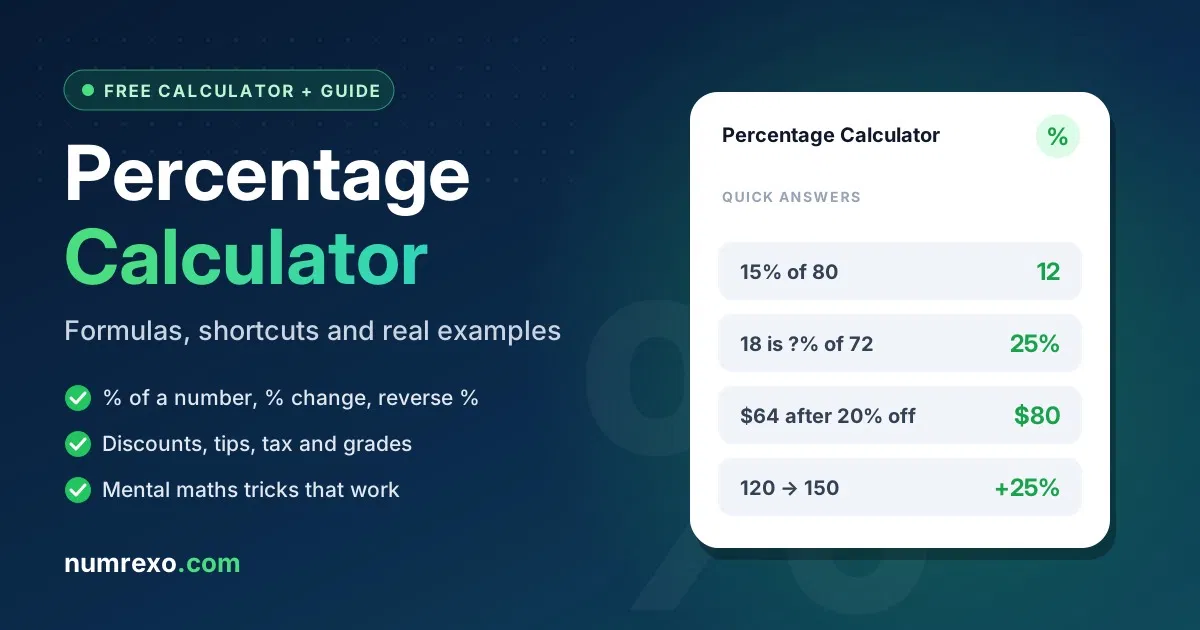
A percentage calculator answers the questions we run into every day: how much is 20% off, what tip to leave, how much your salary went up, or what score you got on a test. You type in two numbers, and it does the maths instantly and without mistakes.
But knowing how percentages work is just as useful as getting the answer. It helps you spot a misleading discount, check a pay rise, and catch errors before they cost you money. This guide covers the formulas, real examples, mental maths shortcuts, and four percentage traps that catch out even people who are good with numbers.
Quick answer: to find X% of a number, multiply the number by X and divide by 100. For example, 15% of 80 = 80 × 15 ÷ 100 = 12.
What is a percentage?
"Per cent" means "per hundred". A percentage is a way of writing a part of something as if the whole were 100.
- 50% means 50 out of 100, or one half
- 25% means 25 out of 100, or one quarter
- 100% means the whole thing
- 150% means one and a half times the whole
Every percentage can also be written as a decimal (divide by 100) or a fraction:
| Percentage | Decimal | Fraction |
|---|---|---|
| 1% | 0.01 | 1/100 |
| 5% | 0.05 | 1/20 |
| 10% | 0.10 | 1/10 |
| 12.5% | 0.125 | 1/8 |
| 20% | 0.20 | 1/5 |
| 25% | 0.25 | 1/4 |
| 33.3% | 0.333 | 1/3 |
| 50% | 0.50 | 1/2 |
| 75% | 0.75 | 3/4 |
Switching to a decimal is the fastest way to calculate. 20% of 45 is simply 0.2 × 45 = 9.
Every percentage problem is one of three questions
Most people find percentages confusing because they mix up which question they are asking. There are only three, and each has its own formula.

1. What is X% of Y?
Result = (X ÷ 100) × Y
Example: what is 15% of 80? 0.15 × 80 = 12.
Use it for: discounts, tips, sales tax, commission, interest for one year.
2. X is what percent of Y?
Percentage = (X ÷ Y) × 100
Example: you scored 18 out of 72. 18 ÷ 72 × 100 = 25%.
Use it for: test scores, budget shares, what share of your income goes on rent.
3. X is Y% of what number?
Whole = X ÷ (Y ÷ 100)
Example: 30 is 40% of what? 30 ÷ 0.40 = 75.
Use it for: finding an original price, a total budget, or a full amount when you only know a part.
A good percentage calculator lets you choose the question first, so you never use the wrong formula.
Percentage increase and decrease
To find how much something changed in percentage terms:
Percentage change = (New value − Old value) ÷ Old value × 100
- Price went from $120 to $150: (150 − 120) ÷ 120 × 100 = +25%
- Price went from $150 to $120: (120 − 150) ÷ 150 × 100 = −20%
Notice that the same $30 difference is a 25% rise one way and a 20% fall the other way. The percentage always depends on the starting value. That small detail is behind most percentage mistakes, as the next sections show.
Adding or removing a percentage
- Add X%: multiply by (1 + X ÷ 100). $80 plus 15% = 80 × 1.15 = $92.
- Remove X%: multiply by (1 − X ÷ 100). $80 minus 15% = 80 × 0.85 = $68.
Reverse percentages: finding the original price
You see a jacket for $64 marked "20% off". What was the original price?
The common mistake is to add 20% back: 64 × 1.20 = $76.80. That is wrong, because the 20% was taken from the original price, not from $64.
The right way: $64 is 80% of the original price, so original = 64 ÷ 0.80 = $80.
The same rule works for taxes. If a receipt shows $108 including 8% sales tax, the price before tax is 108 ÷ 1.08 = $100, not 108 × 0.92 = $99.36.
Rule: to undo a percentage, divide by the same multiplier you used to apply it.
4 percentage traps that fool almost everyone
Trap 1: Stacked discounts don't add up
A store offers 20% off, plus an extra 10% off at checkout. That feels like 30% off. It isn't.

The second discount applies to the already reduced price. On a $100 item: $100 − 20% = $80, then $80 − 10% = $72. You saved 28%, not 30%.
Total discount = 1 − (1 − first discount) × (1 − second discount)
That is why "50% off plus an extra 50% off" is 75% off, not free.
Trap 2: Up X% then down X% is not break-even
Your investment rises 20% one year and falls 20% the next. Are you back where you started? No.
$100 + 20% = $120. Then $120 − 20% = $96. You lost 4%.

There is a neat shortcut: going up X% and then down X% (in either order) always leaves you down by X² ÷ 100 percent. Up and down 10% costs 1%. Up and down 50% costs 25%.
Trap 3: A 50% loss needs a 100% gain to recover
After a drop, you need a bigger percentage rise to get back, because the rise starts from a smaller number.