BMI Calculator: What Your BMI Really Means for Your Health
Sanjay Singh
Published on 19 Aug 2026 • Updated on 5 Oct 2026
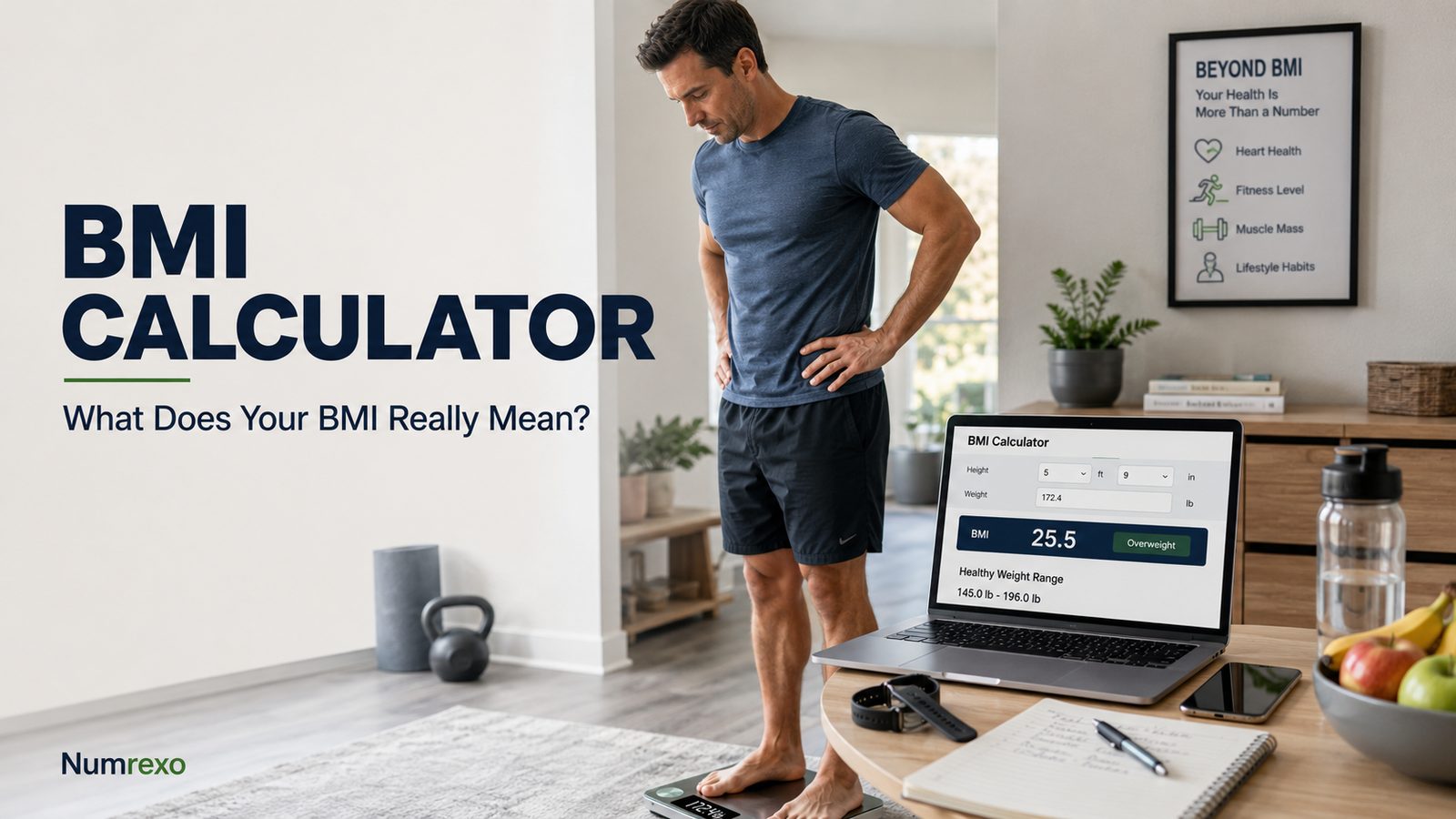
Have you ever stepped on a scale and wondered:
“Is this actually a healthy weight for my height?”
A scale can tell you how much you weigh.
It can't tell you whether that weight is appropriate for your height.
That's one reason Body Mass Index (BMI) has become one of the most widely used screening measures for weight status in adults.
And calculating it takes less than a minute.
But there's a catch.
Your BMI number is useful—but it isn't the complete story about your health.
In this guide, we'll look at what your BMI means, what range is generally considered healthy for adults in the U.S., how BMI differs for men and women, where the measurement falls short, and how to interpret your result without jumping to conclusions.
Calculate Your BMI
If you already know your height and weight, you can calculate your BMI immediately with the Numrexo BMI Calculator.
[Calculate Your BMI with Numrexo →]
For U.S. users, BMI can be calculated using pounds, feet, and inches, so you don't have to convert everything manually.
Once you have your number, the next question is much more important:
What does it actually mean?
What Is BMI?
BMI stands for Body Mass Index.
It is a calculation based on your weight relative to your height.
The standard adult formula is:
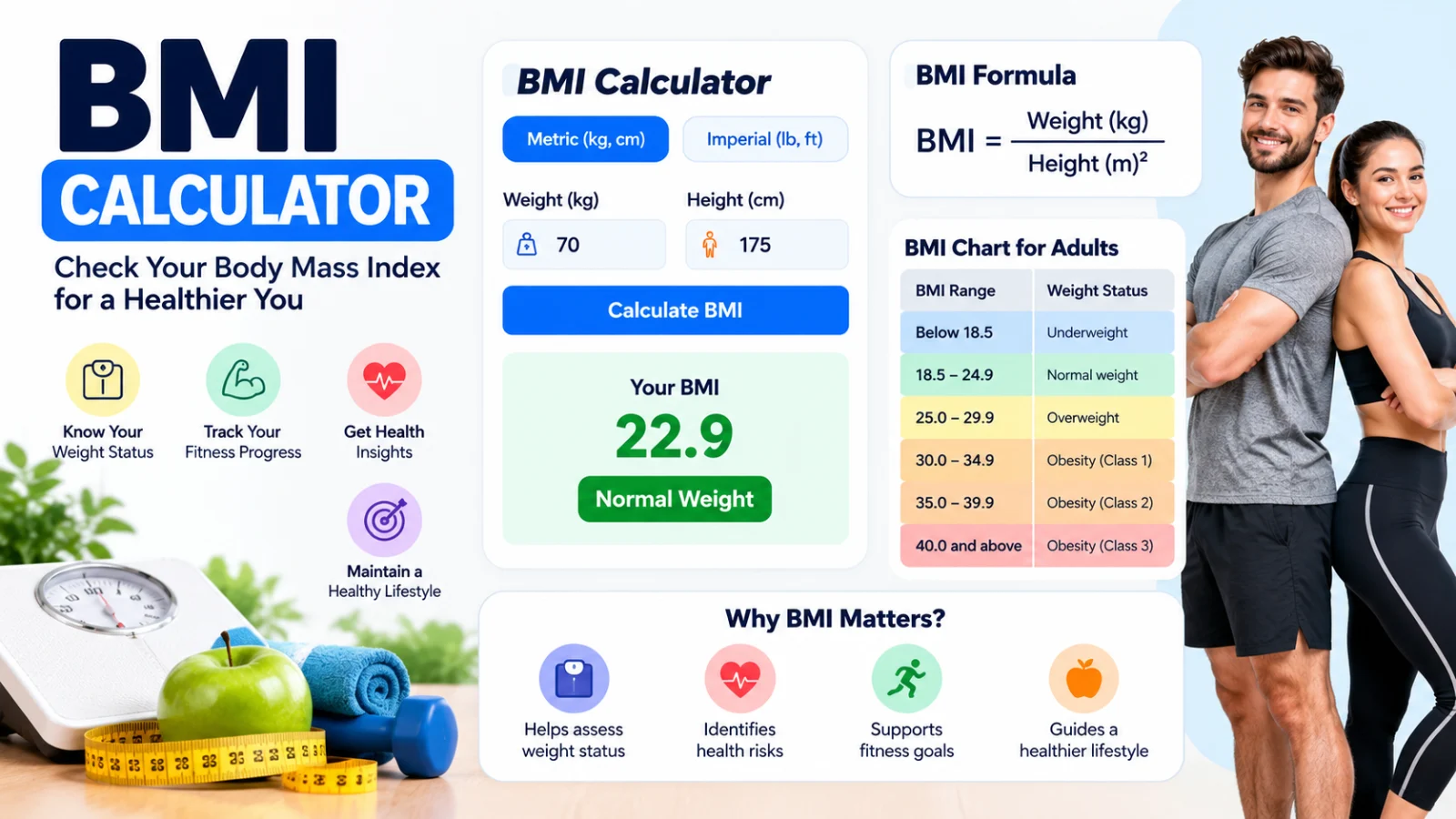
BMI = weight (kg) ÷ height² (m²)
For example, someone who weighs 180 pounds and is 5 feet 10 inches tall has a BMI of approximately 25.8.
That number falls into the overweight category according to standard adult BMI classifications.
But don't panic when you see the word "overweight."
BMI is a screening tool, not a diagnosis.
The CDC specifically notes that BMI should be considered together with factors such as medical history, health behaviors, physical examination findings, and laboratory results.
That distinction is critical.
What Is a Healthy BMI?
For most adults, a BMI from:
18.5 to 24.9
is classified as healthy weight.
The standard adult categories are:
| BMI | Category |
|---|---|
| Below 18.5 | Underweight |
| 18.5–24.9 | Healthy weight |
| 25.0–29.9 | Overweight |
| 30.0–34.9 | Obesity, Class 1 |
| 35.0–39.9 | Obesity, Class 2 |
| 40.0+ | Obesity, Class 3 |
These categories are used for adult men and women.
Notice something interesting:
There isn't a separate "healthy BMI range" for adult men and women.
The standard adult cutoff ranges are the same.
What differs between individuals is the context surrounding the number.
Is a BMI of 22 Better Than 24?
Not necessarily.
Both fall within the standard healthy-weight category.
A BMI of 22 isn't automatically healthier than a BMI of 24 simply because the number is lower.
This is one reason it is better to think of BMI as a range, rather than chasing the smallest possible number.
Your overall health also depends on:
- Blood pressure
- Cholesterol
- Blood glucose
- Physical activity
- Diet
- Sleep
- Waist circumference
- Smoking
- Family history
- Existing medical conditions
- Body composition
BMI gives you one piece of information.
It doesn't give you the entire puzzle.
BMI for Men vs. BMI for Women
For adults, the standard BMI categories are the same for men and women.
That means:
18.5–24.9 = healthy-weight category
for both adult men and women.
But that doesn't mean BMI tells the entire story equally well for every person.
Men and women can have different body-fat distributions and body compositions at the same BMI.
Two people can have identical:
height + weight + BMI
and still have noticeably different amounts and distributions of body fat.
This is one reason health professionals may also consider waist circumference, body composition, blood pressure, metabolic markers, and other measurements.
The NHLBI specifically notes that BMI is a screening measure and that waist circumference can provide additional information about health risk.
Why BMI Is Still Useful
If BMI has limitations, why do doctors and public-health organizations still use it?
Because it is:
Simple.
Fast.
Inexpensive.
Standardized.
You only need two measurements:
Height + weight
That makes BMI extremely useful for population research and initial health screening.
The CDC uses BMI to monitor obesity trends across the United States, and the 2024 adult obesity prevalence maps show that every U.S. state and territory had an adult obesity prevalence of at least 25%.
That's a significant public-health issue.
But it also explains why BMI is used as a starting point rather than a complete diagnosis.
What Does a BMI of 25 Mean?
A BMI of 25.0 crosses the conventional threshold from healthy weight into the overweight category.
But one decimal point should not suddenly change how you think about your health.
Consider two hypothetical adults:
Person A
BMI: 24.9
Person B
BMI: 25.0
They are technically placed into different categories.
But their health isn't automatically different because one number is 24.9 and the other is 25.0.
This illustrates an important principle:
BMI categories are useful boundaries for screening, not magical biological switches.
What Does a BMI of 30 Mean?
A BMI of 30 or higher falls within the obesity category for adults.
This deserves more attention because higher BMI is associated with increased risk for several chronic health conditions.
The CDC notes that obesity is associated with conditions including type 2 diabetes, heart disease, stroke, and certain cancers.
The U.S. Preventive Services Task Force also recommends screening adults for obesity and recommends intensive, multicomponent behavioral interventions for adults with BMI ≥30.
But again:
BMI ≥30 does not tell you everything about an individual person's health.
It tells you that further evaluation may be worthwhile.
The Biggest Problem With BMI
Here's the criticism of BMI that deserves more attention.
BMI doesn't directly measure body fat.
It uses weight and height.
That's it.
Imagine two 5'10" men who both weigh 210 pounds.
One is a highly muscular athlete.
The other has relatively little muscle and a higher proportion of body fat.
Their BMI could be identical.
Their body composition could be very different.
The CDC and NHLBI both acknowledge this limitation. BMI is useful for screening, but it does not directly diagnose body fatness or capture every aspect of health.
That's why BMI should be interpreted in context.
BMI and Body Fat Percentage Are Not the Same Thing
BMI answers:
“How does my weight compare with my height?”
Body-fat percentage answers a different question:
“What proportion of my body weight is fat?”
They're related, but they aren't interchangeable.
This is especially important for:
- Athletes
- Strength-trained individuals
- People with unusually high muscle mass
- Older adults experiencing muscle loss
- People whose body-fat distribution may increase health risk
If you're interested in going beyond BMI, a Body Fat Calculator can provide another estimate to consider alongside BMI.
BMI and Waist Circumference
Where you carry body fat matters.
Fat concentrated around the abdomen is associated with metabolic and cardiovascular risk.
That's why healthcare professionals may consider waist circumference alongside BMI.
For example, two people can have the same BMI but different waist measurements and therefore potentially different risk profiles.
This is another reason not to treat your BMI as a complete health score.
BMI tells you about weight relative to height.
Waist circumference provides information about fat distribution.
Together, they can be more informative than either measurement alone.
What About BMI and Age?
For adults, the standard BMI category cutoffs generally do not change simply because someone gets older.
However, BMI becomes more complicated with aging because body composition changes.
Older adults can lose muscle mass while maintaining a similar body weight.
That means two people with the same BMI can have very different proportions of muscle and fat.
So if you're an older adult, don't interpret BMI in isolation.
A healthcare professional may consider:
- Muscle mass
- Strength
- Mobility
- Waist circumference
- Nutrition
- Chronic conditions
- Functional health
Is BMI Different for Children?
Yes—and this is important.
The adult BMI chart should not be used to interpret BMI in children and teenagers.
For children and adolescents, BMI is interpreted using age- and sex-specific percentiles because body composition changes during growth.
The CDC's adult BMI calculator is intended for adults aged 20 and older.
If you're calculating BMI for a child or teenager, use an appropriate pediatric BMI-for-age tool and discuss the result with their healthcare professional.
What If Your BMI Is Over 25?
Don't immediately start an extreme diet.
First, understand the number.
A BMI in the overweight range can be a reason to look more closely at your overall health—not a reason to punish yourself.
Consider:
- Your waist circumference
- Blood pressure
- Physical activity
- Eating pattern
- Sleep
- Blood glucose
- Cholesterol
- Family history
- Current medications
- Recent weight changes
If several risk factors are present, the BMI result may become more meaningful.
If your BMI is slightly above 25 but you're otherwise healthy and physically active, the appropriate response may be very different.
Context matters.
Can You Have a "Healthy" BMI and Still Be Unhealthy?
Yes.
This is another reason BMI should never be treated as a complete health score.
Someone can have a BMI in the healthy range and still have:
- High blood pressure
- High cholesterol
- Poor cardiovascular fitness
- Poor diet
- Smoking-related risk
- Insufficient physical activity
- Metabolic abnormalities
A healthy BMI is useful.
But a healthy BMI does not guarantee good health.
Likewise, a BMI outside the healthy range does not tell you everything about an individual's health.
What Should You Do After Calculating Your BMI?
Think of your BMI result as a starting conversation, not a final judgment.
If your BMI is below 18.5
Discuss your weight, nutrition, and any unexplained weight changes with a healthcare professional, particularly if the low weight is unintentional.
If your BMI is 18.5–24.9
Your BMI falls within the standard healthy-weight range.
Focus on maintaining healthy habits rather than chasing a lower number.
If your BMI is 25–29.9
Look at your overall risk profile and lifestyle.
Small, sustainable improvements in nutrition and physical activity may be more useful than aggressive dieting.
If your BMI is 30 or higher
Consider discussing your health and weight-management options with a healthcare professional.
Evidence-based weight-management programs can include nutrition, physical activity, behavioral strategies, and—in appropriate patients—medical treatments.
The Better Way to Think About BMI
Don't ask:
“Is my BMI good or bad?”
Ask:
“What does my BMI tell me, and what information am I missing?”
That question leads to much better health decisions.
Your BMI can tell you whether your weight falls into a standard weight-status category.
It cannot tell you:
- Your exact body-fat percentage
- Your fitness level
- Your blood pressure
- Your cholesterol
- Your blood glucose
- Your muscle mass
- Your complete disease risk
That's why BMI works best as one measurement within a broader health assessment.
Calculate Your BMI With Numrexo
You don't need to manually calculate the formula.
Enter your:
Height
Weight
and let the calculator do the math.
[Calculate Your BMI with Numrexo →]
Once you know your result, don't stop at the number.
Understand what category it falls into.
Then consider the rest of your health picture.
Final Takeaway
BMI is not perfect.
But "not perfect" doesn't mean "useless."
It is a simple, standardized screening measure that can help identify adults who may benefit from a closer look at their weight and health risks.
For most adults:
18.5–24.9 is the standard healthy-weight BMI range.
But your health is bigger than a number.
Your BMI should be considered alongside your body composition, waist circumference, activity level, diet, blood pressure, laboratory results, medical history, and overall lifestyle.
So calculate your BMI.
Understand the result.
Then put it into context.
That's a much smarter way to use BMI.
Frequently Asked Questions
What is a healthy BMI for adults?
For most adults, a BMI between 18.5 and 24.9 falls within the standard healthy-weight category.
Is BMI different for men and women?
The standard adult BMI categories are the same for men and women. However, BMI does not account for differences in body composition or fat distribution between individuals.
Is a BMI of 25 considered healthy?
A BMI of 25.0 is at the beginning of the standard overweight category. However, BMI should be interpreted alongside other health information.
Is BMI an accurate measurement of body fat?
Not directly. BMI is calculated from height and weight and does not directly measure body-fat percentage.
Can muscular people have a high BMI?
Yes. People with substantial muscle mass can have a high BMI even when they have relatively low body fat.
What BMI is considered obese?
For adults, a BMI of 30 or higher falls into the obesity category.
Should I use BMI to decide whether I need to lose weight?
BMI can be a useful screening measure, but it should not be the only factor used to make a personal health decision. Consider discussing your BMI and other risk factors with a qualified healthcare professional.
Medical & Editorial Disclaimer
This article is intended for general educational purposes and does not provide individualized medical advice. BMI is a screening measure and should not be used as a standalone diagnosis of health or disease. If you have concerns about your weight, unexplained weight changes, chronic disease, or a weight-management plan, consult a qualified healthcare professional.
Research basis: This article is informed by current guidance and data from the U.S. Centers for Disease Control and Prevention (CDC), National Heart, Lung, and Blood Institute (NHLBI/NIH), and U.S. Preventive Services Task Force.
Get new calculators & guides by email
Occasional updates when we add a new calculator or publish a useful guide. No spam, unsubscribe anytime.
By subscribing you agree to our Privacy Policy.