BMR Calculator: How Many Calories Does Your Body Burn at Rest?
Sanjay Singh
Published on 19 Aug 2026 • Updated on 30 Sept 2026
Have you ever wondered how many calories your body burns even if you stayed in bed all day?
No workout.
No steps.
No running.
No gym.
Just breathing, sleeping, thinking, keeping your heart beating, maintaining your body temperature, and keeping your organs functioning.
Your body is still using energy.
That baseline energy requirement is what Basal Metabolic Rate (BMR) is designed to estimate.
And here's where things get interesting:
Your BMR can account for a surprisingly large part of the calories you use every day—but it is not the same thing as the number of calories you should eat.
That's the mistake behind a lot of online calorie advice.
So let's break down what your BMR actually means, how it's calculated, how accurate a BMR calculator can be, and how you can use the number intelligently for weight loss, maintenance, or muscle gain.
First: Calculate Your BMR
If you want the number before reading the science, start here.
[Calculate Your BMR with the Numrexo BMR Calculator →]
Enter your:
- Age
- Sex
- Height
- Weight
- Activity level
Numrexo uses established predictive equations to estimate BMR and can also help estimate Total Daily Energy Expenditure (TDEE).
But don't just look at the final number.
The interesting part is understanding what that number actually means.
What Is BMR, Exactly?
BMR stands for Basal Metabolic Rate.
In simple terms, it is an estimate of how much energy your body needs to support essential functions under resting conditions.
Think about everything happening inside you right now:
Your heart is pumping blood.
Your lungs are exchanging oxygen and carbon dioxide.
Your brain is consuming energy.
Your kidneys are filtering waste.
Your cells are maintaining themselves.
Your body is regulating temperature.
None of that requires a treadmill.
But it does require energy.
That energy requirement is why your body doesn't suddenly stop burning calories when you stop exercising.
The important distinction
BMR ≠ your daily calorie requirement.
Your actual daily energy expenditure is higher because you also:
- Walk
- Work
- Exercise
- Digest food
- Stand
- Move around your home
- Fidget
- Perform thousands of small movements you barely notice
That's why BMR is a starting point, not the final answer.
BMR vs. TDEE: The Difference Most People Miss
Imagine your BMR is 1,600 calories per day.
That doesn't mean you should eat 1,600 calories.
It means your estimated baseline energy requirement is around that level under resting conditions.
Now add:
Walking + exercise + daily movement + digestion + normal activities
and your total energy expenditure becomes higher.
That's your TDEE — Total Daily Energy Expenditure.
A simple way to remember it:
BMR tells you about your baseline. TDEE tells you about your whole day.
The NIH's Body Weight Planner similarly incorporates body size, age, sex, and physical activity when estimating energy needs and planning weight change.
So How Does a BMR Calculator Know Your Number?
It doesn't actually "see" your metabolism.
It estimates it.
Most online calculators use mathematical equations developed from human research.
One of the most widely used is the Mifflin-St Jeor equation.
The original research was published in the American Journal of Clinical Nutrition in 1990.
For men:
BMR = 10 × weight (kg) + 6.25 × height (cm) − 5 × age + 5
For women:
BMR = 10 × weight (kg) + 6.25 × height (cm) − 5 × age − 161
You don't need to calculate this by hand.
That's exactly why a BMR calculator is useful.
Here's a Real-World Example
Consider a hypothetical 35-year-old man:
- Height: 5'10"
- Weight: 180 lb
- Age: 35
A calculator can convert the measurements and estimate his resting energy needs.
But here's the important part:
That number is not his "daily calorie limit."
If he has a desk job but walks regularly, goes to the gym three times a week, cooks dinner, shops for groceries, and stays generally active, his body will use considerably more energy than his BMR.
This is why someone can have a BMR of 1,700 calories and still require well over 2,000 calories per day to maintain body weight.
How Accurate Is a BMR Calculator?
This is where we need to be honest.
A BMR calculator is useful.
But it isn't a metabolic laboratory.
The most direct way to measure resting energy expenditure is through indirect calorimetry, which measures respiratory gases under controlled conditions.
Most people obviously aren't going to a laboratory just to find out their resting calorie expenditure.
So prediction equations are useful shortcuts.
A systematic review comparing commonly used equations found that Mifflin-St Jeor generally performed better than several other commonly used equations, including Harris-Benedict, Owen, and WHO/FAO/UNU equations. But the researchers also emphasized that meaningful errors can occur for individuals.
That's an important distinction.
A calculator can give you a useful estimate.
It cannot promise your exact metabolic rate.
Why Your "Calculated" Metabolism May Not Match Your Reality
Let's say your calculator gives you:
1,650 calories/day
but your real-world experience doesn't seem to match that number.
That doesn't automatically mean you have a "slow metabolism."
Prediction equations can't perfectly capture every biological difference between people.
Your energy expenditure can be influenced by factors including:
- Age
- Body size
- Body composition
- Sex
- Physical activity
- Health conditions
- Medications
- Individual biological variation
Research has found that prediction accuracy varies between populations and individuals. In one study, the Mifflin-St Jeor equation performed well overall, but accuracy was lower among participants with obesity than among non-obese participants.
So don't treat your BMR number like a laboratory result.
Use it as a starting estimate.
Does Having More Muscle Increase Calorie Burn?
This is one of the most misunderstood areas of metabolism.
Muscle is metabolically active tissue, so body composition matters.
But online fitness culture often exaggerates the effect by suggesting that gaining a few pounds of muscle will suddenly cause you to burn hundreds of additional calories every day.
Human metabolism is more complicated than that.
Your resting energy expenditure reflects the combined energy requirements of your body's tissues and physiological processes.
So yes, body composition matters.
But "build muscle and your metabolism will skyrocket" is not a scientifically useful way to think about it.
BMR and Weight Loss: What Should You Actually Do?
Here's a much better way to use your BMR.
Step 1: Estimate your BMR
Use the Numrexo BMR Calculator.
Step 2: Estimate your TDEE
Account for your normal physical activity.
Step 3: Decide your goal
Are you trying to:
- Lose weight?
- Maintain weight?
- Gain muscle?
Step 4: Create a realistic calorie strategy
Your calorie target should be based on your overall energy needs and individual circumstances—not simply your BMR number.
Step 5: Watch what happens in the real world
Your body gives you feedback.
Track your weight trend, activity, food intake, and progress over time.
Then adjust.
This is far more useful than treating a single calculator result as absolute truth.
"Can I Eat Below My BMR to Lose Weight?"
This is one of the most common questions people ask.
The short answer:
Don't use your BMR as a magic minimum-calorie rule.
Your BMR is an estimate of baseline energy expenditure. It isn't a universal prescription for the minimum amount every adult should eat.
Very-low-calorie diets can be medically appropriate in specific circumstances under professional supervision, but they should not be casually copied from an internet calculator.
If you're trying to lose a significant amount of weight, especially if you have a medical condition or take medications, individualized guidance from a qualified healthcare professional is more appropriate.
The NIH's Body Weight Planner is specifically designed for adults and also cautions that it isn't intended for children or people who are pregnant or breastfeeding.
BMR for Weight Loss vs. Muscle Gain
Your BMR doesn't change its meaning depending on your goal.
Your strategy changes.
If your goal is weight loss
You generally need your energy intake to be below your overall energy expenditure over time.
If your goal is maintenance
Your intake and expenditure need to be reasonably balanced over time.
If your goal is muscle gain
You may need additional energy combined with appropriate resistance training and sufficient protein.
In every case, BMR is the starting layer.
TDEE and your actual results provide the bigger picture.
Can Exercise "Speed Up" Your Metabolism?
Exercise absolutely increases energy expenditure.
But "speeding up metabolism" is often used too loosely.
Regular physical activity improves much more than calorie burn.
For U.S. adults, the CDC recommends at least:
150 minutes of moderate-intensity aerobic activity per week
or
75 minutes of vigorous aerobic activity
plus
muscle-strengthening activity on at least 2 days per week.
Exercise can also support cardiovascular health, physical function, sleep, and overall health.
So don't exercise simply because you want your BMR number to increase.
Exercise because your body benefits from moving.
Why Two People With the Same Weight Can Have Different Calorie Needs
This is where BMR becomes particularly interesting.
Imagine two people who both weigh:
180 lb
They might still have different energy requirements.
Why?
Because body weight alone doesn't describe a person's:
- Height
- Age
- Sex
- Body composition
- Activity level
- Physiological characteristics
That's why a calorie target copied from a friend, influencer, or social media post may be completely inappropriate for you.
Your numbers are yours.
That's the reason personalized calculators exist.
BMR Calculator vs. Calorie Calculator: Which One Should You Use?
They answer different questions.
| Tool | Main Question |
|---|---|
| BMR Calculator | How much energy does my body need at rest? |
| Calorie Calculator | How many calories might I need based on activity and goals? |
| TDEE Calculator | How much energy might I use across a typical day? |
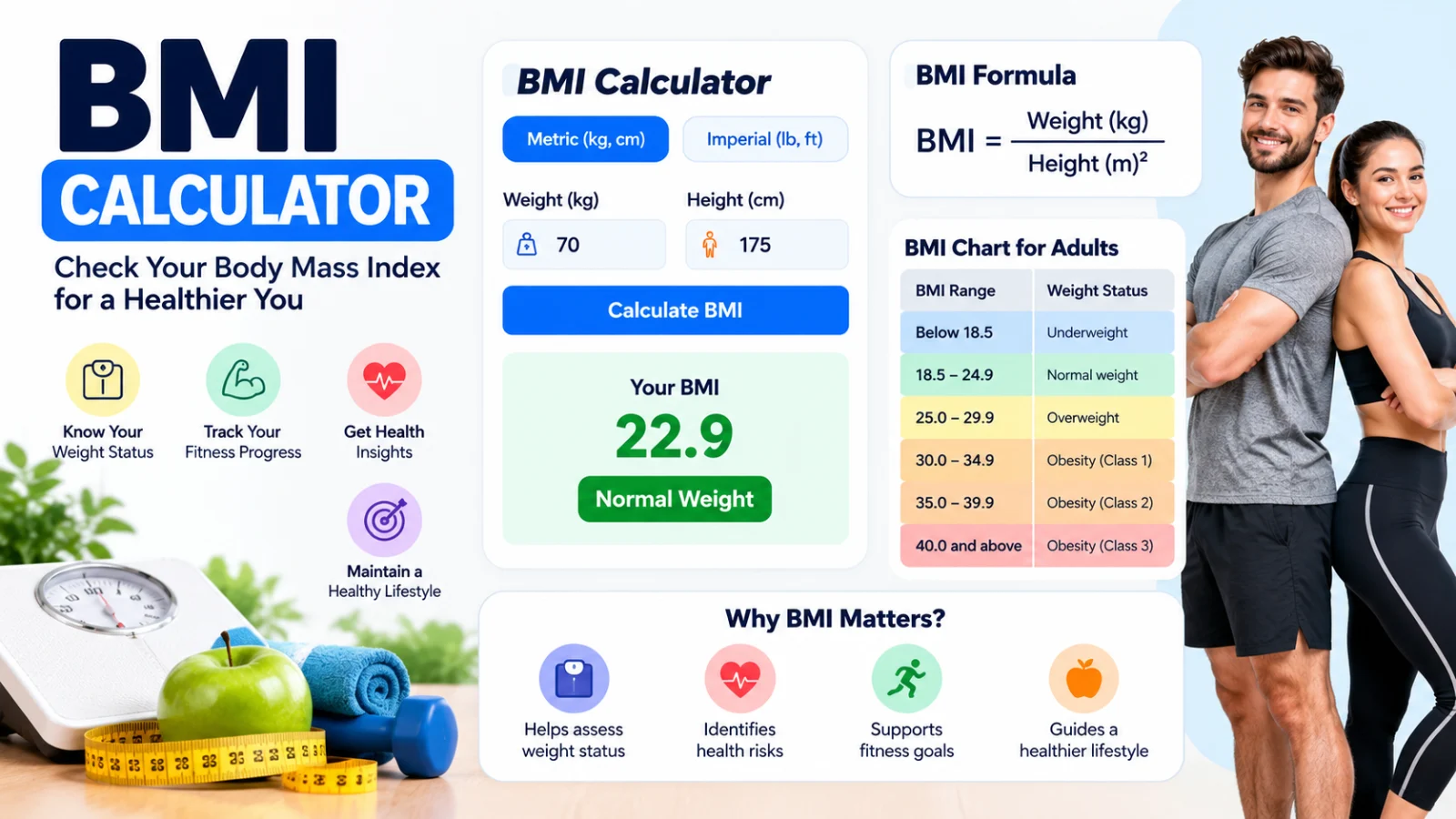
| BMI Calculator | How does my weight compare with height using BMI? |
If you're beginning a weight-management plan, using these tools together can give you a much more complete picture.
What Can Make a BMR Estimate Less Reliable?
A calculator becomes less useful when you assume it knows things that it cannot measure.
For example, a basic BMR equation doesn't directly measure:
- Your actual muscle mass
- Your exact body composition
- Your individual metabolic adaptation
- Your medical history
- Your hormone levels
- Your medication effects
That's why researchers continue to evaluate and compare predictive equations.
A 2023 systematic review of athletes found that the accuracy of resting metabolic rate equations varied substantially across populations and that no single equation was guaranteed to be superior for every athlete.
The lesson isn't that calculators are useless.
It's that you should understand what they can—and cannot—tell you.
The Smart Way to Use Your BMR Result
Here's the approach I'd recommend:
Don't ask:
"What is my exact metabolism?"
Ask:
"What is a reasonable starting estimate for my energy needs?"
That's a much better question.
Use the calculator.
Build a reasonable plan.
Monitor your real-world response.
Then adjust when necessary.
That approach is more realistic because human metabolism isn't a perfectly predictable spreadsheet.
The Bottom Line
Your body doesn't stop burning calories when your workout ends.
It doesn't stop when you sit at your desk.
And it certainly doesn't stop when you sleep.
Your heart, brain, lungs, kidneys, muscles, and countless cellular processes continue using energy around the clock.
BMR is an estimate of that baseline energy requirement.
But don't make the mistake of turning one number into your entire nutrition strategy.
Use BMR as the starting point.
Use activity to understand your TDEE.
Use your goals to determine your strategy.
And use your real-world progress to decide whether that strategy is working.
Ready to see your number?
Calculate your BMR with the Numrexo BMR Calculator →
Then use the result as what it is meant to be:
a useful starting point—not a verdict on your metabolism.
Frequently Asked Questions
What does BMR stand for?
BMR stands for Basal Metabolic Rate. It estimates the energy your body requires to support essential physiological functions at rest.
Is BMR the same as the calories I should eat?
No. Your daily calorie needs are generally higher than your BMR because you also expend energy through physical activity, movement, digestion, and other processes.
What is the most accurate BMR formula?
Mifflin-St Jeor is one of the better-supported commonly used prediction equations for general adult populations, but no equation is perfectly accurate for every individual.
Does a higher BMR mean a faster metabolism?
Generally, a higher resting energy expenditure means your body uses more energy at rest, but "fast metabolism" is an oversimplification because total daily energy expenditure includes much more than BMR.
Can I use BMR for weight loss?
Yes, as a starting point. But weight-loss calorie planning should consider your total daily energy expenditure rather than using BMR alone.
Should I eat below my BMR?
Don't use BMR as a universal minimum-calorie rule. Individual calorie needs and medical circumstances vary.
Can I calculate BMR in pounds and feet?
Yes. A properly designed calculator can convert U.S. customary measurements such as pounds and feet/inches into the units required by the equation.
Research & Medical Disclaimer
This article is intended for educational purposes and does not provide individualized medical or nutrition advice. BMR calculations are estimates, not direct measurements of metabolism. If you have a medical condition, unexplained changes in weight, are pregnant or breastfeeding, have an eating disorder, or require a medically supervised nutrition plan, consult an appropriately qualified healthcare professional.
Research cited in this article includes peer-reviewed studies evaluating resting metabolic rate prediction equations and guidance from the U.S. National Institutes of Health/NIDDK.
Get new calculators & guides by email
Occasional updates when we add a new calculator or publish a useful guide. No spam, unsubscribe anytime.
By subscribing you agree to our Privacy Policy.