BMR vs TDEE: Which One Should You Actually Use to Lose Weight?
Sanjay Singh
Published on 9 Jul 2026 • Updated on 30 Sept 2026
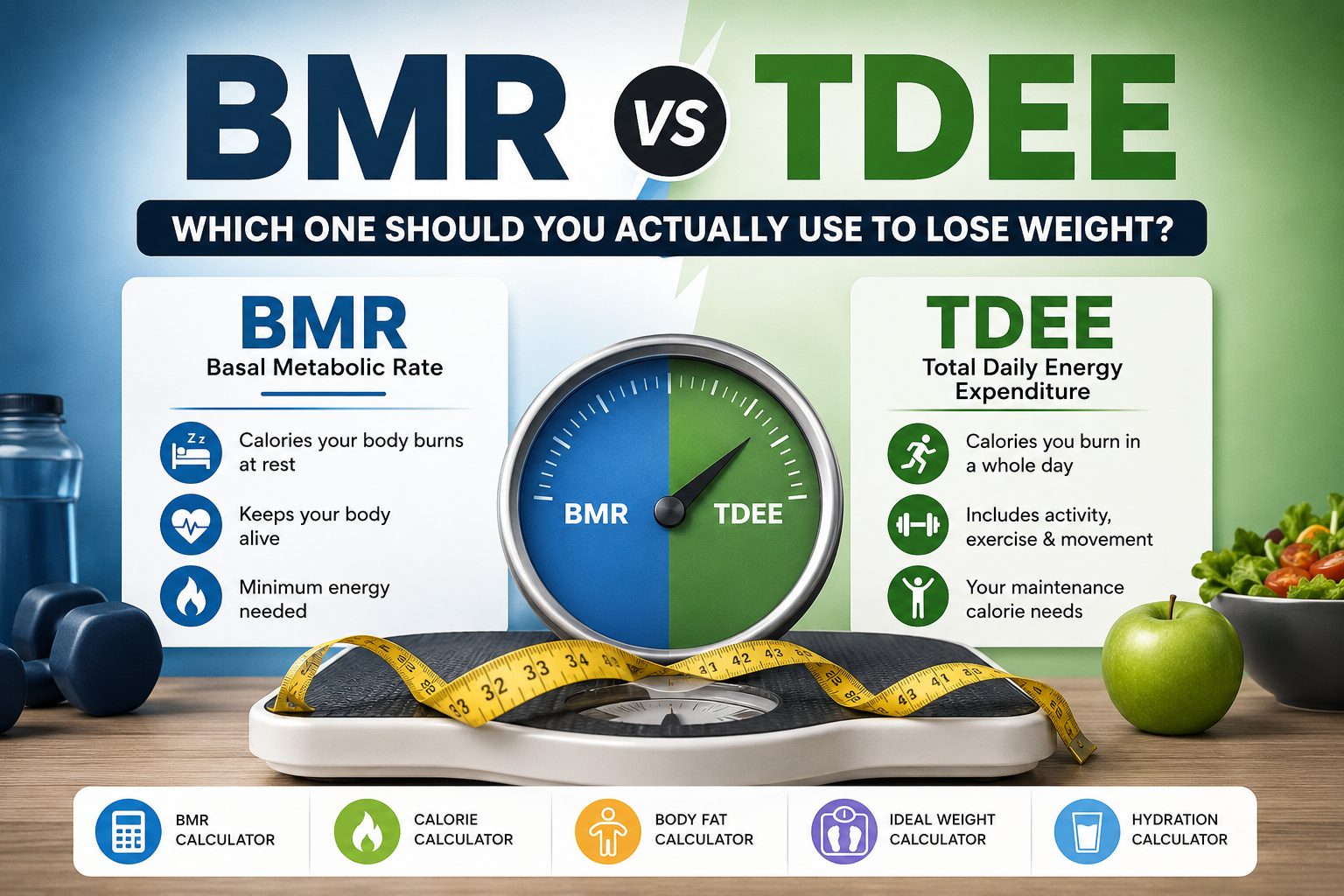
You calculated your BMR and started eating exactly that many calories. Weeks later, the scale hasn't budged — or worse, you're exhausted all the time. Here's the problem: BMR vs TDEE isn't just a technical distinction, it's the difference between a smart deficit and accidentally starving yourself. Let's sort out which number actually belongs on your meal plan.
What BMR Actually Is
BMR stands for Basal Metabolic Rate — the calories your body burns just to keep you alive if you did absolutely nothing all day. No walking, no talking, not even sitting up. Just lying in bed, breathing, digesting, keeping your heart beating.
It's calculated using the Mifflin-St Jeor equation, which is the formula most nutrition professionals and calculators rely on because it's held up well against actual metabolic testing.
For men: (10 × weight in kg) + (6.25 × height in cm) − (5 × age) + 5 For women: (10 × weight in kg) + (6.25 × height in cm) − (5 × age) − 161
Let's use a real example. A 30-year-old man weighing 70 kg (about 154 lbs) and 175 cm tall (roughly 5'9"):
(10 × 70) + (6.25 × 175) − (5 × 30) + 5 = 700 + 1093.75 − 150 + 5 = 1648.75 kcal
So this person burns roughly 1,650 calories a day even if he never leaves the couch. That's his BMR. Notice something? It has nothing to do with his job, his workouts, or how many steps he takes. That's exactly where the confusion starts.
If you'd rather skip the manual math, the BMR Calculator gives you this number in seconds using the same validated formula.
What TDEE Adds to the Picture
TDEE — Total Daily Energy Expenditure — takes that baseline BMR number and adds everything else you actually do in a day. Walking to your car, climbing stairs, gym sessions, fidgeting at your desk, all of it.
The formula is simple: TDEE = BMR × activity multiplier
Using our same 1,650 kcal BMR, here's how it shifts depending on lifestyle:
- Sedentary (desk job, little to no exercise): 1,650 × 1.2 = 1,980 kcal
- Moderately active (desk job + regular gym sessions, 3–5 days a week): 1,650 × 1.55 = 2,557 kcal
- Very active (physical job or intense daily training): 1,650 × 1.725 = 2,846 kcal
Same person, same BMR — but a nearly 900-calorie swing depending on how active they actually are. That gap is huge, and it's exactly why using the wrong number wrecks people's progress.
The Mistake Almost Everyone Makes
Here's the part that trips people up constantly: weight loss deficits should come off your TDEE, not your BMR.
Your BMR is what your organs need to function. It was never meant to be a calorie target — it's a survival floor. If you're eating at your BMR long-term, you're basically starving your body of the energy it needs for daily movement, workouts, hormone production, even basic focus.
The correct approach: figure out your TDEE, then subtract a moderate deficit from that — typically 300 to 500 kcal for sustainable fat loss. Using our example, someone who's moderately active with a TDEE of 2,557 kcal should be eating somewhere around 2,057–2,257 kcal to lose weight steadily, not 1,650.
Eat at your BMR instead of your TDEE and you'll likely hit a wall fast — low energy, poor workouts, and metabolic adaptation where your body starts conserving calories out of self-preservation. Ironically, that often stalls fat loss rather than speeding it up.
Turning the Numbers Into a Plan
Once you know your TDEE, the rest becomes math instead of guesswork. A Calorie Calculator can help you fine-tune your daily target based on your specific goal — cutting, maintaining, or bulking.
Pair that with your Body Fat Calculator result to track actual fat loss instead of just watching the scale, which can be misleading if you're gaining muscle at the same time. And if you're not sure what weight range you're even aiming for, the Ideal Weight Calculator gives you a realistic target based on your height and frame.
It's also worth checking your BMI Calculator result alongside these numbers — not as a final verdict on your health, but as one more data point in the bigger picture.
These numbers are estimates — for medical or clinical nutrition advice, consult a registered dietitian or doctor, especially if you have a medical condition affecting your metabolism.
FAQs
Should I eat at my BMR or TDEE? Neither, exactly — you should eat below your TDEE, not at your BMR. Your BMR is a survival minimum, not a diet target. Base your calorie deficit on TDEE.
Is TDEE the same as maintenance calories? Yes. TDEE and maintenance calories mean the same thing — the amount you'd eat to keep your weight stable at your current activity level.
How much deficit is safe below TDEE? A deficit of 300–500 kcal below TDEE is generally considered sustainable for most people, leading to roughly 0.5–1 lb (0.25–0.5 kg) of fat loss per week.
Why am I not losing weight even though I'm in a deficit? Often it's because the "deficit" was calculated from BMR instead of TDEE, meaning you're not actually eating below your true maintenance level. Recalculating with an accurate TDEE usually fixes this.
Does TDEE change as I lose weight? Yes. As body weight drops, both BMR and TDEE decrease slightly, since a smaller body needs less energy. Recalculating every 4–6 weeks keeps your numbers accurate.
Stop guessing — calculate your actual TDEE with the BMR Calculator, apply a moderate deficit, and give your body the fuel it needs to actually let go of fat.
Get new calculators & guides by email
Occasional updates when we add a new calculator or publish a useful guide. No spam, unsubscribe anytime.
By subscribing you agree to our Privacy Policy.