Ideal Weight Calculator: How to Find Your Healthy Weight by Height
Sanjay Singh
Published on 15 Sept 2026 • Updated on 30 Sept 2026

Knowing your right weight is not limited to looking in the mirror or standing on a weighing scale. When it comes to fitness, overall health, and improving your lifestyle, one of the first questions that comes to mind is: “What should my ideal weight be according to my height?”
This is where an Ideal Weight Calculator makes things easier. Using scientific formulas and data, it estimates a safe and healthy weight range based on your height and body frame.
In this complete guide, we will understand how ideal body weight is calculated, what different scientific formulas say, and what an accurate height-to-weight chart looks like.
What Is an Ideal Weight Calculator?
An Ideal Weight Calculator is a digital health tool that calculates a target weight based on your biological sex and height.
Many people rely only on Body Mass Index (BMI), but Ideal Body Weight (IBW) calculations are based on established formulas that have been widely used as medical and clinical reference points. Healthcare professionals and fitness trainers may use IBW estimates when setting personalized diet plans, clinical targets, and fitness routines.
4 Most Popular Formulas to Calculate Ideal Body Weight (IBW)
Several validated formulas are used in health science to estimate ideal body weight. Our calculator supports these four standard formulas:
1. Devine Formula (1974)
One of the most widely used formulas for estimating ideal body weight:
Men:
50 kg + 2.3 kg × (Height in inches − 60)
Women:
45.5 kg + 2.3 kg × (Height in inches − 60)
2. Robinson Formula (1983)
A modified approach based on the Devine formula:
Men:
52 kg + 1.9 kg × (Height in inches − 60)
Women:
49 kg + 1.7 kg × (Height in inches − 60)
3. Miller Formula (1983)
Another commonly referenced formula for estimating ideal body weight:
Men:
56.2 kg + 1.41 kg × (Height in inches − 60)
Women:
53.1 kg + 1.36 kg × (Height in inches − 60)
4. Hamwi Formula (1964)
A simple formula commonly used as a reference in clinical nutrition:
Men:
48 kg + 2.7 kg × (Height in inches − 60)
Women:
45.5 kg + 2.2 kg × (Height in inches − 60)
Ideal Height-to-Weight Chart: Quick Reference
If you want a quick reference for the estimated healthy weight range based on height, you can use the following chart:
| Height | Height (cm) | Estimated Weight Range for Men | Estimated Weight Range for Women |
|---|---|---|---|
| 5'0" | 152 cm | 46–54 kg | 43–50 kg |
| 5'2" | 157 cm | 50–59 kg | 47–55 kg |
| 5'4" | 163 cm | 55–64 kg | 51–60 kg |
| 5'6" | 168 cm | 60–70 kg | 56–65 kg |
| 5'8" | 173 cm | 65–75 kg | 60–70 kg |
| 5'10" | 178 cm | 70–81 kg | 65–75 kg |
| 6'0" | 183 cm | 75–87 kg | 70–81 kg |
Note: These ranges are general reference values and are commonly associated with the healthy BMI range of 18.5–24.9. They should not be treated as a strict medical target for every individual.
Difference Between Ideal Body Weight (IBW) and BMI
Both IBW and BMI can be useful for understanding body weight, but they measure different things.
Body Mass Index (BMI)
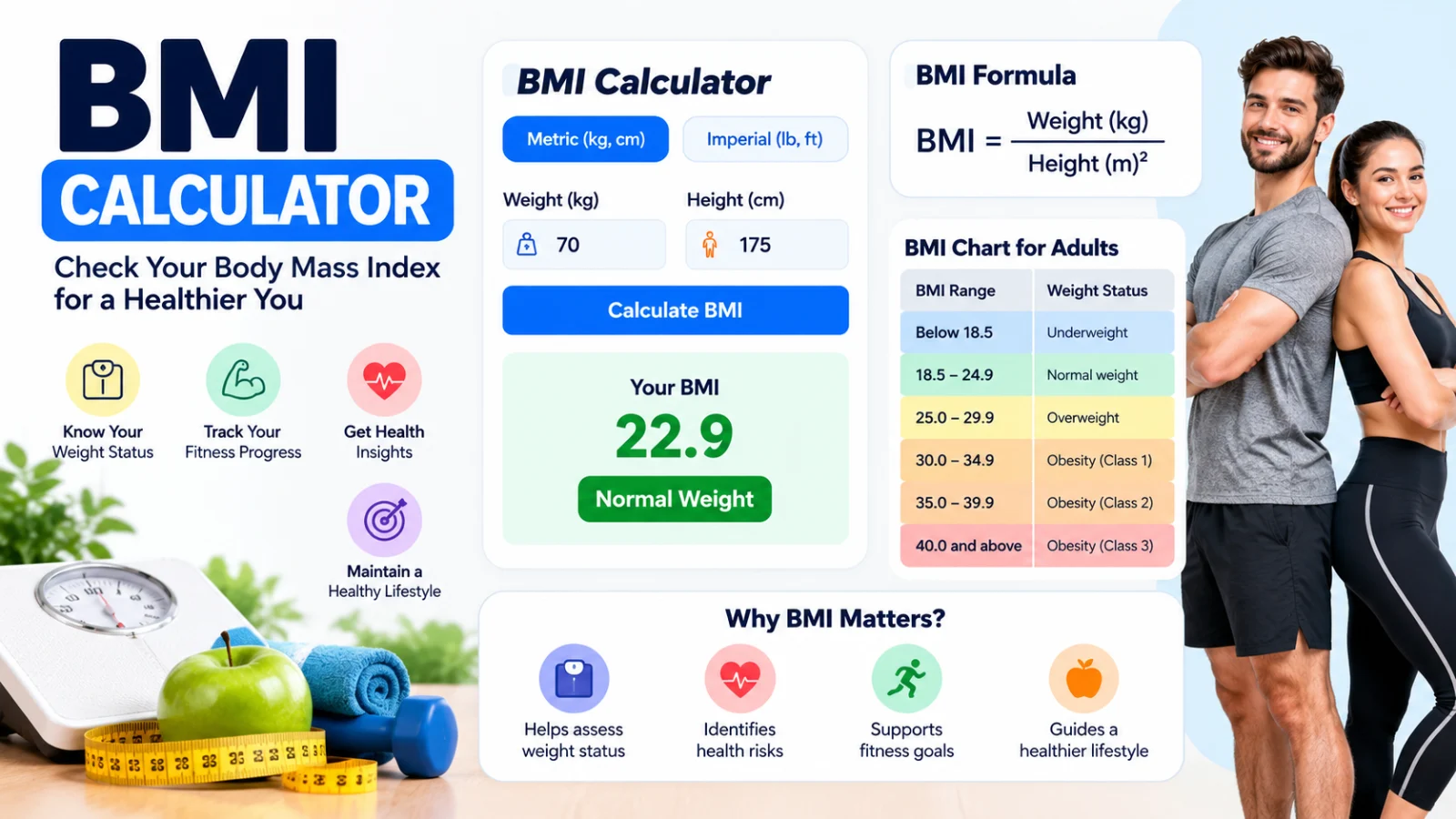
BMI is calculated by dividing your weight by the square of your height. It is commonly used to categorize weight as underweight, healthy weight, overweight, or obesity.
However, BMI has an important limitation: it does not distinguish between muscle mass and body fat. As a result, a muscular person may have a higher BMI even when they have relatively low body fat.
Ideal Body Weight (IBW)
IBW provides an estimated weight based primarily on height and sex using established formulas. It can be useful as a reference point when setting a general weight target, but it does not directly measure body fat, muscle mass, or an individual's complete body composition.
Key Factors That Affect Your Target Weight
The number provided by an ideal weight calculator should be treated as a general reference range rather than a strict rule.
Muscle Mass
Muscle tissue is denser than fat. People who regularly participate in strength training or sports may naturally weigh more than a standard reference range while still having a healthy body composition.
Bone Structure and Frame Size
Body frame and skeletal structure can influence a person's natural weight. People with larger frames may weigh more than those with smaller frames at the same height.
Age and Metabolism
As people age, changes in muscle mass, physical activity, and energy expenditure can affect body weight and body composition.
Body Fat Distribution
Body weight alone does not provide a complete picture of health. Where body fat is stored, particularly around the abdomen, can also be an important health consideration.
5 Practical Steps to Reach and Maintain a Healthy Weight
1. Track Your Daily Calories
Understand your estimated Total Daily Energy Expenditure (TDEE) and adjust your calorie intake according to your goal, whether that is gaining, losing, or maintaining weight.
2. Increase Protein and Fiber
Include foods such as lentils, paneer, sprouts, seasonal vegetables, whole grains, eggs, and other protein-rich foods to support nutrition, satiety, and muscle maintenance.
3. Include Strength Training
Perform basic resistance or bodyweight exercises 3–4 days per week to help build and maintain muscle mass.
4. Stay Hydrated and Prioritize Quality Sleep
Aim for adequate daily fluid intake and 7–9 hours of quality sleep when possible. Good hydration and sleep support overall health, recovery, and physical performance.
5. Track Your Progress Weekly
Instead of focusing on daily fluctuations, monitor your weekly average body weight, waist measurements, fitness performance, and other relevant progress indicators.
Frequently Asked Questions (FAQs)
Q1: Is it normal to be slightly below or above the ideal weight?
Yes. An estimate from an ideal weight calculator is not a strict boundary. Your healthy weight can vary depending on factors such as muscle mass, body composition, bone structure, age, and activity level.
Q2: Is the ideal weight different for men and women at the same height?
Yes. Standard IBW formulas generally provide different estimates for men and women at the same height because the formulas use different reference coefficients. However, individual healthy weight can vary considerably based on body composition and other factors.
Q3: How often should I calculate my ideal weight?
For most adults, height remains relatively stable, so you generally do not need to recalculate your ideal body weight frequently. You can use the calculation as a general reference and monitor your actual weight and body composition over time.
Get new calculators & guides by email
Occasional updates when we add a new calculator or publish a useful guide. No spam, unsubscribe anytime.
By subscribing you agree to our Privacy Policy.