Property Tax Calculator: How to Calculate Property Tax in 2026
Learn how property tax works in 2026, including assessed property value, tax rates, millage rates, exemptions, payment methods, and step-by-step property tax calculations with practical examples.
Sanjay Singh
Published on 8 Nov 2026 • Updated on 8 Nov 2026
What Is Property Tax?
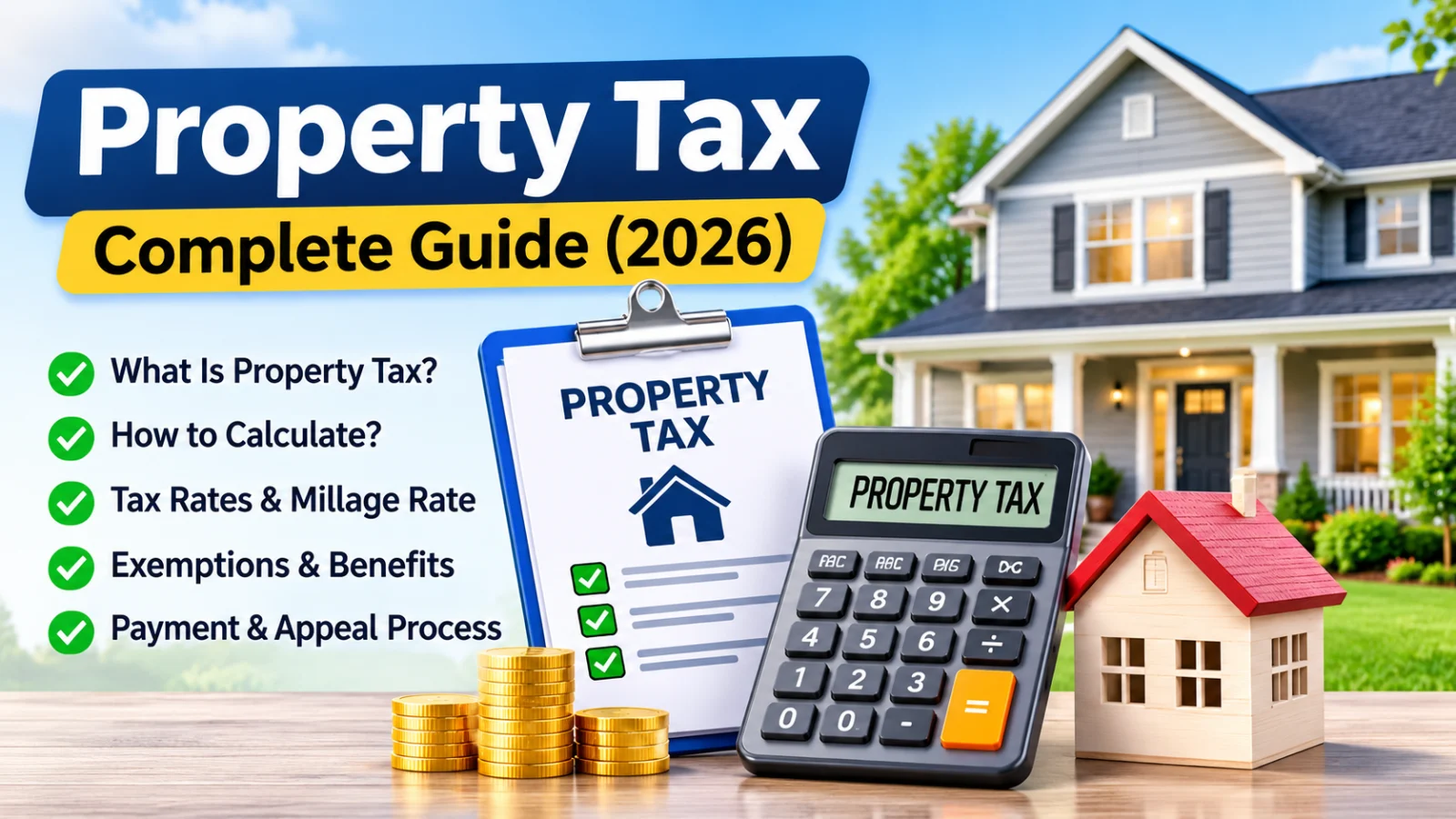
Property tax is an annual or periodic tax imposed by local government authorities on real estate owned by individuals or businesses. It is one of the most important recurring expenses associated with owning a home, commercial building, apartment, or vacant land.

In the United States, property taxes are generally collected by counties, cities, municipalities, school districts, and other local taxing authorities. The revenue helps fund public schools, roads, police departments, fire protection, libraries, parks, and other essential community services.
The amount of property tax you pay depends on several factors, including the property's assessed value, applicable tax rate, local millage rate, property classification, and eligible exemptions.
For homeowners, understanding property tax is essential when purchasing real estate, estimating monthly housing expenses, or planning a long-term budget.
A Property Tax Calculator makes it easier to estimate annual and monthly tax expenses using your property's taxable assessed value and local tax rate.

How Does Property Tax Work?
Property tax is calculated through a process that generally involves property valuation, assessment, exemptions, and the application of local tax rates.
The local property assessor determines the property's assessed value according to applicable state and local regulations. Eligible exemptions and assessment adjustments are then considered to determine the taxable value.
Finally, the local tax rate is applied to the taxable value to calculate the amount owed.
The general process includes:
- Property valuation: The local assessor estimates the property's value.
- Property assessment: The applicable assessment ratio or assessment rules are applied.
- Exemptions: Eligible tax exemptions are deducted.
- Tax rate: The local tax rate or millage rate is applied.
- Tax bill: The tax authority calculates and issues the property tax bill.
- Payment: The property owner pays the amount according to the local payment schedule.
Property tax rules differ across states and counties. Therefore, two properties with similar market values may have different property tax bills because of differences in assessment rules, exemptions, and local tax rates.
Property Tax Calculation Formula
The basic property tax formula is:
Property Tax = Taxable Assessed Value × Property Tax Rate
If the local authority uses a millage rate, the formula is:
Property Tax = (Taxable Assessed Value × Millage Rate) ÷ 1,000
Here is what each term means:
- Taxable Assessed Value: The assessed property value after applicable exemptions and adjustments.
- Property Tax Rate: The percentage of taxable property value charged as tax.
- Millage Rate: The amount of tax charged for every $1,000 of taxable assessed value.
Property Tax Calculation Example
Suppose you own a residential property with the following details:
| Description | Amount |
|---|---|
| Assessed Property Value | $320,000 |
| Eligible Tax Exemptions | $50,000 |
| Taxable Assessed Value | $270,000 |
| Local Millage Rate | 18 mills |
Step 1: Calculate taxable property value
$320,000 - $50,000 = $270,000
The taxable assessed value is $270,000.
Step 2: Convert the millage rate
18 mills means $18 in tax for every $1,000 of taxable value.
18 ÷ 1,000 = 0.018
Step 3: Calculate annual property tax
$270,000 × 0.018 = $4,860
Therefore:
- Annual Property Tax: $4,860
- Monthly Equivalent: $405
- Quarterly Equivalent: $1,215
This is an illustrative example. Actual property tax calculations depend on local assessment rules and applicable tax rates.
What Is Assessed Property Value?
Assessed property value is the value assigned to real estate by a local government authority for property taxation purposes.
It is not always equal to the property's purchase price or current market value.
For example, assume a residential property has a market value of $400,000. If the applicable assessment ratio is 80%, the assessed value would be:
$400,000 × 80% = $320,000
The assessed property value would be $320,000.
Assessment ratios vary by state, county, and property classification. Some jurisdictions also apply assessment caps or other limitations that affect taxable property values.
Factors That Affect Assessed Property Value
Several factors may influence property assessments:
- Location and neighborhood.
- Land size and property dimensions.
- Building age and physical condition.
- Number of bedrooms and bathrooms.
- Recent comparable property sales.
- Renovations and property improvements.
- Local real estate market conditions.
- Applicable property classification rules.
Local assessors may reassess properties periodically according to state and local requirements.
What Is a Property Tax Rate?
A property tax rate is the rate used by local taxing authorities to calculate taxes on a property's taxable assessed value.
Property tax rates are not identical throughout the United States. They vary based on local government budgets, public service requirements, school district funding, and the total taxable property value within a jurisdiction.
Property tax rates are commonly expressed in two ways.
1. Percentage-Based Property Tax Rate
Some jurisdictions express property tax rates as a percentage.
For example, if your taxable property value is $300,000 and the tax rate is 1.5%, the calculation is:
$300,000 × 1.5% = $4,500
The annual property tax would be $4,500.
2. Millage-Based Property Tax Rate
Other jurisdictions use a millage system.
One mill represents $1 in tax for every $1,000 of taxable assessed property value.
Examples:
- 5 mills = $5 per $1,000.
- 10 mills = $10 per $1,000.
- 15 mills = $15 per $1,000.
- 20 mills = $20 per $1,000.
A millage rate of 20 mills is equivalent to a 2% tax rate.
Who Determines Property Tax Rates?
Property assessors generally determine assessed property values, while local taxing authorities determine the tax revenue they need and establish applicable tax rates through local budget processes.
These authorities may include:
- County governments.
- City and municipal governments.
- School districts.
- Special taxing districts.
- Other local public authorities.
Your total tax bill may combine multiple local tax rates.
What Are Property Tax Exemptions?
Property tax exemptions are tax benefits provided by state and local governments to eligible property owners.
They generally reduce the taxable assessed value of a property, which can lower the amount of property tax owed.
The availability and amount of exemptions depend on local regulations.
1. Homestead Exemption
A homestead exemption is generally available to eligible homeowners who use a property as their primary residence.
It may reduce the taxable assessed value of an eligible home.
For example, if a property has an assessed value of $250,000 and qualifies for a $25,000 exemption, the taxable value may become $225,000, subject to local rules.
2. Senior Citizen Exemption
Some jurisdictions offer property tax exemptions, reductions, or deferrals to qualifying senior citizens.
Eligibility may depend on age, household income, ownership, and primary residence requirements.
3. Disability Exemption
Eligible homeowners with qualifying disabilities may receive property tax relief under certain state and local programs.
The required documentation and exemption amounts vary by jurisdiction.
4. Veterans Exemption
Some states provide property tax exemptions or reductions to eligible military veterans.
Additional benefits may be available to veterans with qualifying service-connected disabilities.
5. Agricultural Property Exemption
Agricultural land may qualify for special assessment methods or tax benefits when it meets applicable agricultural use requirements.
These programs are generally designed to support farming and agricultural activities.
Important: Exemptions are not available everywhere, and some require a separate application. Check your local assessor's rules before calculating your final tax liability.
What Types of Properties Are Subject to Property Tax?
Property tax generally applies to different types of real estate, depending on state and local laws.
Residential Property
Residential property includes single-family homes, apartments, condominiums, and other buildings used for living purposes.
Homeowners are generally responsible for paying property taxes based on their taxable assessed property value.
Commercial Property
Commercial properties include office buildings, retail stores, shopping centers, hotels, and other buildings used for business activities.
Commercial properties may have different assessment classifications and tax rules.
Vacant Land
Undeveloped land may be subject to property tax even when no building or structure exists on the property.
Its taxable value generally depends on location, land characteristics, classification, and local assessment rules.
Industrial Property
Industrial property includes factories, warehouses, manufacturing facilities, and other properties used for industrial activities.
The assessment may include land, buildings, and taxable improvements.
Rental and Investment Properties
Rental properties and investment homes are generally subject to property taxes.
The property owner is normally responsible for paying the tax, even when the property is rented to tenants.
How Often Do You Pay Property Tax?
Property tax payment schedules depend on the local tax authority.
Some jurisdictions collect property taxes annually, while others allow homeowners to pay in multiple installments.
Common payment arrangements include:
- Annual payments.
- Semiannual payments.
- Quarterly payments.
- Monthly mortgage escrow contributions.
For example, if your annual property tax is $4,800:
$4,800 ÷ 12 = $400
You would need to budget approximately $400 per month to cover the annual property tax expense.
However, your actual payment deadlines and installment options should be confirmed with your local tax collector.
How to Pay Property Tax?
Most local tax authorities provide different payment options for property owners.
Online Payment
Many counties allow homeowners to pay property taxes through official online payment portals.
Bank Transfer
Some local tax authorities accept electronic bank transfers through supported payment systems.
Check or Money Order
Certain jurisdictions allow payments by mailing a check or money order.
In-Person Payment
Property owners may be able to visit the local tax collector's office to make payments.
Mortgage Escrow Account
If your mortgage includes an escrow arrangement, your lender may collect monthly amounts for property taxes and pay the tax authority when the bill becomes due.
Always verify the official payment instructions, deadlines, and processing fees before making a payment.
What Happens If You Do Not Pay Property Tax?
Failing to pay property taxes by the applicable deadline can result in financial and legal consequences.
Depending on local laws, these may include:
- Late payment penalties.
- Interest on outstanding tax amounts.
- Additional collection fees.
- Property tax liens.
- Tax foreclosure proceedings.
- Potential loss of the property through the applicable legal process.
A property tax lien is a legal claim against a property because of unpaid taxes.
If the outstanding balance remains unpaid, the local government may initiate further collection or foreclosure proceedings as permitted by law.
If you cannot pay your tax bill on time, contact your local tax collector to ask whether payment plans, installment arrangements, or tax relief programs are available.
How to Appeal Your Property Tax Assessment?
If you believe your property has been assessed at an incorrect value, you may have the right to appeal the assessment.
An appeal allows property owners to challenge their assessed property value through the relevant local administrative process.
Follow these general steps:
Step 1: Review Your Assessment Notice
Check the assessed value, property description, land area, building details, and applicable exemptions.
Step 2: Compare Similar Properties
Review recent sales of comparable properties in your neighborhood.
Step 3: Identify Assessment Errors
Look for incorrect measurements, inaccurate property details, or valuation errors.
Step 4: Collect Supporting Documents
Useful supporting documents may include:
- Recent comparable property sales.
- Property photographs.
- Independent valuation reports.
- Property condition reports.
- Assessment records.
Step 5: Submit an Appeal
File your appeal with the appropriate local assessment review board or authority before the filing deadline.
Step 6: Attend a Hearing if Required
Present your supporting evidence and explain why the assessment should be reconsidered.
An appeal does not guarantee a lower property tax bill. The result depends on the available evidence and local appeal procedures.
Are Property Taxes Deductible?
Property taxes may qualify for a federal income tax deduction in the United States, subject to applicable IRS rules.
Generally, qualifying state and local real estate taxes may be included in the State and Local Tax (SALT) itemized deduction on Schedule A of Form 1040.
For the 2026 tax year, the general SALT deduction limit is $40,400 for most individual filers and $20,200 for married individuals filing separately. The limit may be reduced for taxpayers with modified adjusted gross income above the applicable threshold.
Important considerations:
- You generally need to itemize deductions to claim eligible property taxes.
- The deduction is subject to the overall SALT limit.
- Homeowners association fees are not deductible as real estate taxes.
- Certain special assessments and service charges are not deductible.
- Rental and business properties may follow different tax treatment.
Tax regulations can change. Review the latest IRS instructions or consult a qualified tax professional before claiming a deduction.
Property Tax vs. Real Estate Tax: What Is the Difference?
Property tax and real estate tax are often used interchangeably in the United States.
However, property tax can have a broader meaning because it may also include taxes on certain taxable personal property.
| Feature | Property Tax | Real Estate Tax |
|---|---|---|
| Meaning | Tax on taxable property | Tax on real estate |
| Coverage | Real and certain personal property | Land and buildings |
| Calculation | Depends on property classification | Based on taxable real estate value |
| Tax Authority | State or local authority | State or local authority |
| Examples | Real estate and certain taxable vehicles | Houses, apartments, commercial buildings |
For homeowners, both terms generally refer to recurring taxes imposed on real estate.
Factors That Can Increase or Decrease Property Tax
Your property tax bill may change from one year to another.
Several factors can influence the final amount.
| Factor | Potential Effect |
|---|---|
| Increase in assessed value | May increase tax |
| Increase in local tax rate | May increase tax |
| Property improvements | May increase assessed value |
| Additional exemptions | May reduce tax |
| Assessment limitations | May restrict increases |
| Local government budget changes | May change tax rates |
| Property classification changes | May change tax liability |
An increase in market value does not necessarily mean that your property tax bill will increase by the same percentage. Assessment limits, exemptions, and local tax rates also affect the final amount.
How to Estimate Your Annual Property Tax Budget
Property taxes should be included in your overall homeownership budget.
When evaluating a property, consider more than its purchase price and mortgage payment.
Your housing expenses may include:
- Mortgage principal and interest.
- Property taxes.
- Homeowners insurance.
- Home maintenance.
- Homeowners association fees.
- Utilities.
- Other applicable local charges.
Monthly Homeownership Expense Example
Suppose a homeowner has the following estimated expenses:
| Expense | Monthly Cost |
|---|---|
| Mortgage Payment | $1,800 |
| Property Tax | $400 |
| Home Insurance | $150 |
| HOA Fees | $100 |
| Maintenance Budget | $150 |
| Total Monthly Expenses | $2,600 |
This example demonstrates why property tax should be included when estimating the actual cost of homeownership.
How to Use a Property Tax Calculator
A Property Tax Calculator helps estimate the amount of tax payable on a property using its taxable assessed value and local tax rate.
To estimate your property tax:
- Find the assessed value of your property.
- Identify any applicable property tax exemptions.
- Subtract eligible exemptions to determine taxable value.
- Enter the applicable local tax rate or millage rate.
- Calculate the estimated annual property tax.
- Divide the annual amount by 12 to estimate the monthly equivalent.
For example, a property with a taxable assessed value of $270,000 and a millage rate of 18 mills has an estimated annual property tax of $4,860.
A calculator can help you compare different property values, tax rates, and exemption scenarios before making a real estate decision.
Frequently Asked Questions About Property Tax
1. What is property tax?
Property tax is a tax imposed by local governments on real estate and certain other taxable property. It is generally calculated using the property's taxable assessed value and the applicable tax rate.
2. How is property tax calculated?
Property tax is calculated by multiplying the taxable assessed value of a property by the applicable local tax rate. When a millage rate is used, multiply taxable value by the millage rate and divide by 1,000.
3. What is the difference between assessed value and market value?
Market value is the estimated price at which a property could sell under normal market conditions. Assessed value is the value assigned by the local assessor for taxation purposes.
4. What is a millage rate?
A millage rate is the amount of property tax charged for every $1,000 of taxable assessed property value. One mill equals $1 per $1,000.
5. Can I reduce my property tax?
You may be able to reduce your property tax through eligible exemptions, assessment appeals, or local tax relief programs. Eligibility depends on your location and circumstances.
6. What is a homestead exemption?
A homestead exemption is a tax benefit available in certain jurisdictions to eligible homeowners who use a property as their primary residence. It generally reduces the taxable assessed value.
7. Do I pay property tax if I have a mortgage?
Yes. Having a mortgage does not eliminate your property tax obligation. Your lender may collect property taxes through an escrow account, or you may pay the local tax authority directly.
8. What happens if I miss my property tax payment deadline?
Missing the deadline may result in penalties, interest, collection fees, or a property tax lien. Further legal action may occur if the outstanding balance remains unpaid.
9. Are rental properties subject to property tax?
Yes. Rental and investment properties are generally subject to property taxes. The owner is normally responsible for paying the tax.
10. Are property taxes based on the purchase price?
Not necessarily. Property taxes are generally based on assessed value under local assessment rules, which may differ from the property's purchase price.
11. Can I appeal my property tax assessment?
Yes. Many jurisdictions allow property owners to appeal an assessment if they believe the property has been incorrectly valued. You must follow the local appeal process and meet the filing deadline.
12. How can I find my property's assessed value?
You can generally find your assessed value through your local county assessor's website, property assessment records, or assessment notice.
13. Do vacant properties have property taxes?
Yes. Vacant land and certain unoccupied properties may remain subject to property taxes even when they are not generating rental income.
14. Are property taxes and HOA fees the same?
No. Property taxes are government-imposed taxes, whereas HOA fees are payments made to a homeowners association for community maintenance and shared services.
15. How can I calculate monthly property tax?
Divide the estimated annual property tax by 12. For example, if your annual property tax is $6,000, the monthly equivalent is $500.
Conclusion
Property tax is an important recurring expense associated with owning real estate in the United States. Understanding assessed property values, local tax rates, millage rates, and available exemptions can help homeowners make better financial decisions.
Whether you are purchasing your first home, managing rental properties, or evaluating a commercial real estate investment, estimating property taxes in advance can help you prepare a realistic ownership budget. https://www.numrexo.com/finance/mortgage-calculator?utm_source=chatgpt.com link text
Always review the latest property assessment records, local tax rates, available exemptions, and payment requirements before making a financial decision.
Use the Numrexo Property Tax Calculator to estimate annual and monthly property tax expenses and plan your homeownership budget more effectively.
Frequently Asked Questions
FAQ 1: What is property tax?▾
Property tax is a local government tax imposed on real estate based on its taxable assessed value and applicable tax rate.
FAQ 2: How do I calculate property tax?▾
Multiply the taxable assessed property value by the local property tax rate. For millage rates, multiply the taxable value by the millage rate and divide by 1,000.
FAQ 3: What is a property tax calculator?▾
A property tax calculator is an online tool that estimates annual and monthly property tax expenses using property value, exemptions, and local tax rates.
FAQ 4: What is a millage rate?▾
A millage rate represents the amount of tax charged for every $1,000 of taxable assessed property value. One mill equals $1 per $1,000.
FAQ 5: Can I reduce my property tax?▾
Yes. Eligible homeowners may reduce their property taxes through homestead exemptions, senior citizen benefits, disability exemptions, or assessment appeals, depending on local regulations.
FAQ 6: Is property tax paid monthly or yearly?▾
Property tax payment schedules vary by jurisdiction. Some authorities collect taxes annually, while others allow semiannual or quarterly installments.
FAQ 7: What happens if property tax is not paid?▾
Unpaid property taxes may result in penalties, interest, tax liens, and potentially foreclosure proceedings under applicable local laws.
FAQ 8: Are property taxes deductible in the USA?▾
Eligible state and local property taxes may qualify for a federal itemized deduction, subject to IRS rules and applicable SALT limits.
Get new calculators & guides by email
Occasional updates when we add a new calculator or publish a useful guide. No spam, unsubscribe anytime.
By subscribing you agree to our Privacy Policy.