Pythagorean Theorem: Formula, Examples & How to Find the Missing Side of a Right Triangle
ythagorean Theorem Calculator Pythagorean Theorem Formula Hypotenuse Calculator Right Triangle Calculator Find Missing Side of a Triangle
Sanjay Singh
Published on 4 Nov 2026 • Updated on 4 Nov 2026
Pythagorean Theorem: Formula, Definition, Examples, and Applications
Meta Title: Pythagorean Theorem: Formula, Examples & Calculator Guide
Meta Description: Learn the Pythagorean Theorem formula, how to calculate the hypotenuse and missing sides of a right triangle, solved examples, and real-life applications.
Focus Keyword: Pythagorean Theorem
Secondary Keywords: Pythagorean Theorem formula, Pythagorean Theorem calculator, hypotenuse calculator, right triangle formula, find missing side of a triangle
Introduction
The Pythagorean Theorem is one of the most important concepts in geometry. It helps us calculate the length of an unknown side of a right-angled triangle when the other two sides are known.
Whether you are a student solving geometry problems, a teacher explaining mathematical concepts, or someone working on construction and measurement projects, understanding the Pythagorean Theorem can make calculations much easier.
This theorem is widely used in mathematics, engineering, architecture, construction, navigation, and many other practical applications.
In this guide, you will learn what the Pythagorean Theorem is, how its formula works, how to solve different types of problems, and how to calculate missing sides using a simple method.
What Is the Pythagorean Theorem?
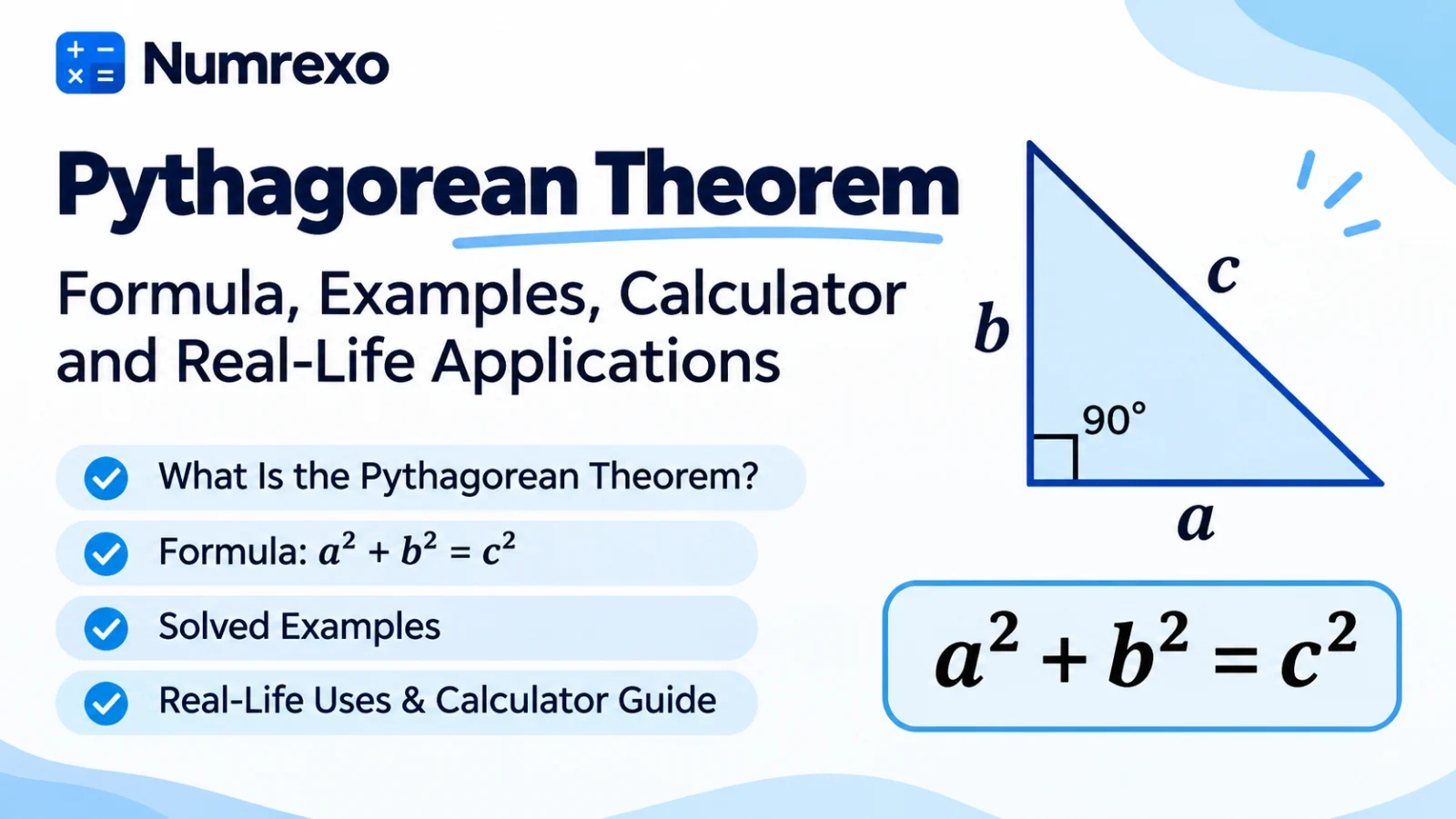
The Pythagorean Theorem states that in a right-angled triangle, the square of the hypotenuse is equal to the sum of the squares of the other two sides.
A right-angled triangle is a triangle that contains one angle measuring exactly 90 degrees.
The theorem is named after the ancient Greek mathematician Pythagoras, although similar mathematical relationships were known in earlier civilizations.
The theorem applies only to right-angled triangles.
Pythagorean Theorem Formula
The standard mathematical formula is:
a² + b² = c²
Where:
- a: Length of the first shorter side (leg)
- b: Length of the second shorter side (leg)
- c: Length of the hypotenuse (the longest side)
The hypotenuse is always opposite the 90-degree angle.
If you know the lengths of both shorter sides, you can calculate the hypotenuse. If you know the hypotenuse and one shorter side, you can calculate the remaining side.
How to Calculate the Hypotenuse
The hypotenuse is the longest side of a right triangle.
When the lengths of both shorter sides are known, use the following formula:
c = √(a² + b²)
Example 1: Find the Hypotenuse
Suppose a right triangle has:
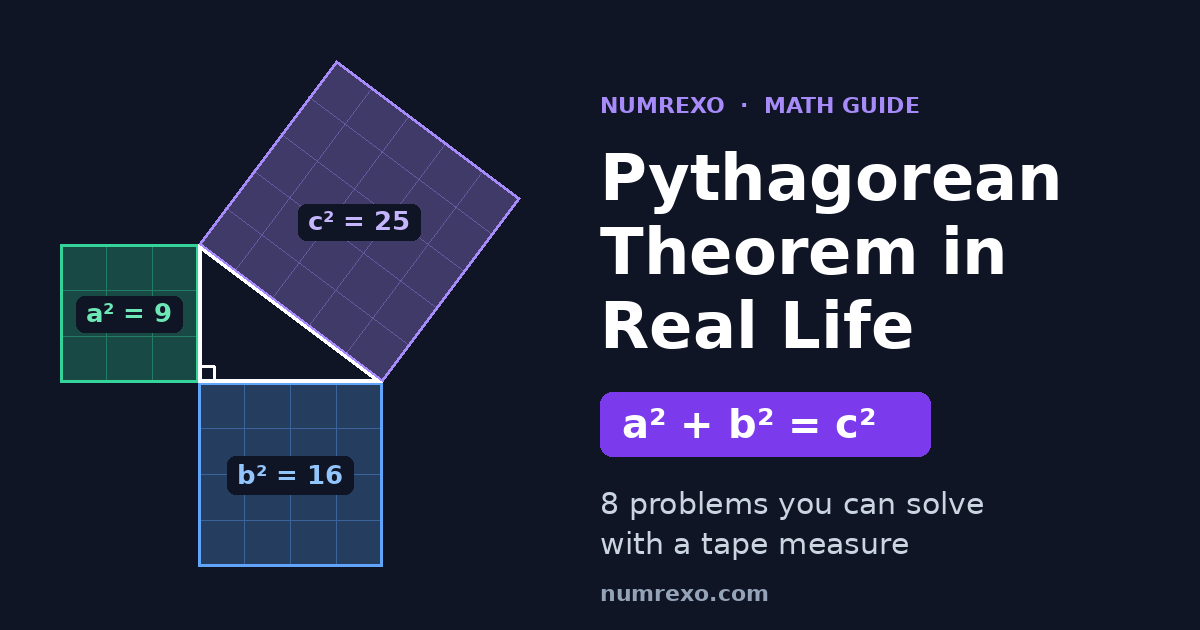
- Side a = 3 cm
- Side b = 4 cm
Step 1: Square both sides.
3² = 9
4² = 16
Step 2: Add the squared values.
9 + 16 = 25
Step 3: Calculate the square root.
√25 = 5
Answer: The hypotenuse is 5 cm.
This creates a 3-4-5 right triangle, which is one of the most commonly used examples of the Pythagorean Theorem.
How to Find a Missing Side of a Right Triangle
The Pythagorean Theorem can also be used when the hypotenuse and one shorter side are known.
Example 2: Find the Missing Shorter Side
Suppose:
- Hypotenuse = 13 cm
- Known shorter side = 5 cm
- Missing shorter side = b
The formula becomes:
b = √(c² − a²)
Step 1: Square the hypotenuse.
13² = 169
Step 2: Square the known side.
5² = 25
Step 3: Subtract the squared values.
169 − 25 = 144
Step 4: Calculate the square root.
√144 = 12
Answer: The missing side is 12 cm.
The resulting triangle has side lengths of 5 cm, 12 cm, and 13 cm.
Pythagorean Theorem Examples
Here are some additional examples to help you understand how the theorem works.
| Side A | Side B | Hypotenuse |
|---|---|---|
| 3 | 4 | 5 |
| 5 | 12 | 13 |
| 8 | 15 | 17 |
| 7 | 24 | 25 |
| 9 | 12 | 15 |
These are examples of Pythagorean triples. They are sets of three positive integers that satisfy the theorem.
Pythagorean triples are especially useful when solving geometry problems because they provide exact integer answers.
What Is a Pythagorean Theorem Calculator?
A Pythagorean Theorem Calculator is an online mathematical tool that helps you calculate the missing side of a right triangle without performing every calculation manually.
You can use it to find:
- The hypotenuse when both shorter sides are known.
- A missing shorter side when the hypotenuse and another side are known.
- The length of a triangle's sides using square roots and basic arithmetic.
A calculator is useful for students, teachers, engineers, architects, and anyone who needs accurate right-triangle measurements.
How to Use a Pythagorean Theorem Calculator
Follow these simple steps:
- Identify the two known sides of your right triangle.
- Enter their values into the calculator.
- Select the side you want to calculate, if required.
- Click the Calculate button.
- Review the calculated missing side.
For example, entering 6 and 8 as the two shorter sides gives a hypotenuse of 10.
Always ensure that the triangle is right-angled before using the calculator.
Real-Life Applications of the Pythagorean Theorem
The Pythagorean Theorem is not limited to classroom mathematics. It is used in several real-world situations.
1. Construction and Architecture
Builders use the theorem to check whether walls, floors, and foundations form right angles.
A 3-4-5 triangle is a common practical method for establishing a 90-degree angle during construction.
2. Finding the Length of a Ladder
Suppose a ladder is placed against a wall.
The wall, ground, and ladder form a right triangle.
If the ladder is 10 feet long and its base is 6 feet from the wall, the height reached by the ladder is:
Height = √(10² − 6²)
Height = √64
Height = 8 feet
The ladder reaches 8 feet up the wall.
3. Calculating Diagonal Distance
The theorem can be used to calculate the diagonal of a rectangular room, screen, field, or piece of land.
For example, a rectangular room measuring 12 feet by 16 feet has a diagonal of:
Diagonal = √(12² + 16²)
Diagonal = √400
Diagonal = 20 feet
4. Navigation and Distance Measurement
When traveling horizontally and vertically between two locations, the theorem helps calculate the straight-line distance between them.
It is also useful in coordinate geometry and certain navigation calculations.
5. Engineering and Physics
Engineers use the theorem to calculate distances, resolve perpendicular components, and analyze geometric relationships in structures and mechanical systems.
Difference Between the Pythagorean Theorem and Its Converse
The Pythagorean Theorem and its converse are related but serve different purposes.
Pythagorean Theorem: If a triangle is right-angled, the squares of its two shorter sides add up to the square of its hypotenuse.
Converse of the Pythagorean Theorem: If the square of the longest side equals the sum of the squares of the other two sides, the triangle is right-angled.
For example, a triangle with sides 3, 4, and 5 is right-angled because:
3² + 4² = 5²
9 + 16 = 25
This relationship confirms that the triangle has a 90-degree angle.
Common Mistakes to Avoid
When solving Pythagorean Theorem problems, students often make a few common mistakes.
- Applying the theorem to a triangle that is not right-angled.
- Confusing the hypotenuse with one of the shorter sides.
- Adding the sides directly instead of adding their squares.
- Forgetting to calculate the square root after adding or subtracting the squared values.
- Using the subtraction formula incorrectly when finding a missing shorter side.
Remember that the hypotenuse is always the longest side and is located opposite the right angle.
Conclusion
The Pythagorean Theorem is a fundamental mathematical concept that makes calculating the sides of right-angled triangles straightforward.
By understanding how the theorem works, you can solve geometry problems, calculate diagonal distances, and apply mathematical principles to real-world situations.
Whether you need to find the hypotenuse or determine a missing shorter side, the theorem provides a reliable method for accurate calculations. link text link text
Use the Pythagorean Theorem Calculator on Numrexo to calculate missing triangle sides quickly and simplify your mathematical calculations.
Frequently Asked Questions
1. What is the Pythagorean Theorem?▾
The Pythagorean Theorem is a mathematical rule that states the square of the hypotenuse of a right-angled triangle equals the sum of the squares of its other two sides.
2. What is the formula for the Pythagorean Theorem?▾
The formula is a² + b² = c², where a and b are the shorter sides and c is the hypotenuse.
3. What is the hypotenuse of a triangle?▾
The hypotenuse is the longest side of a right-angled triangle. It is always opposite the 90-degree angle.
4. How do you calculate the hypotenuse?▾
Use the formula c = √(a² + b²). Square both shorter sides, add the results, and calculate the square root.
5. How do you find a missing side of a right triangle?▾
If the hypotenuse and one shorter side are known, use the formula b = √(c² − a²) to calculate the missing side.
6. Can the Pythagorean Theorem be used for any triangle?▾
No. The Pythagorean Theorem applies only to right-angled triangles that contain one angle measuring exactly 90 degrees.
7. What is a Pythagorean triple?▾
A Pythagorean triple is a set of three positive integers that satisfy the Pythagorean Theorem. Examples include 3-4-5, 5-12-13, and 8-15-17.
8. What is the most common Pythagorean triple?▾
The 3-4-5 triple is one of the most common Pythagorean triples. It is frequently used in geometry and construction to establish right angles.
9. How do you find the diagonal of a rectangle using the Pythagorean Theorem?▾
Use the formula d = √(l² + w²), where l is the length and w is the width of the rectangle.
10. What is the difference between a leg and a hypotenuse?▾
The legs are the two sides that form the right angle. The hypotenuse is the longest side, located opposite the right angle.
11. How is the Pythagorean Theorem used in real life?▾
It is used in construction, architecture, engineering, navigation, and distance measurement to calculate unknown lengths and diagonal distances.
12. What is the converse of the Pythagorean Theorem?▾
The converse states that if the square of the longest side equals the sum of the squares of the other two sides, the triangle is a right-angled triangle.
13. Can the Pythagorean Theorem calculate decimal values?▾
Yes. The theorem can calculate both integer and decimal side lengths. The result may be a decimal or an irrational number.
14. How can I calculate a missing triangle side online?▾
You can use a Pythagorean Theorem Calculator by entering the known side lengths. The calculator applies the appropriate formula to find the missing side.
15. Why is the Pythagorean Theorem important in mathematics?▾
The Pythagorean Theorem is important because it connects geometry and algebra. It helps solve triangle problems and forms the foundation for coordinate geometry, distance calculations, and many advanced mathematical concepts.
Get new calculators & guides by email
Occasional updates when we add a new calculator or publish a useful guide. No spam, unsubscribe anytime.
By subscribing you agree to our Privacy Policy.