What Your Number Really Means (And When It's Wrong)
Sanjay Singh
Published on 4 Jul 2026 • Updated on 30 Sept 2026
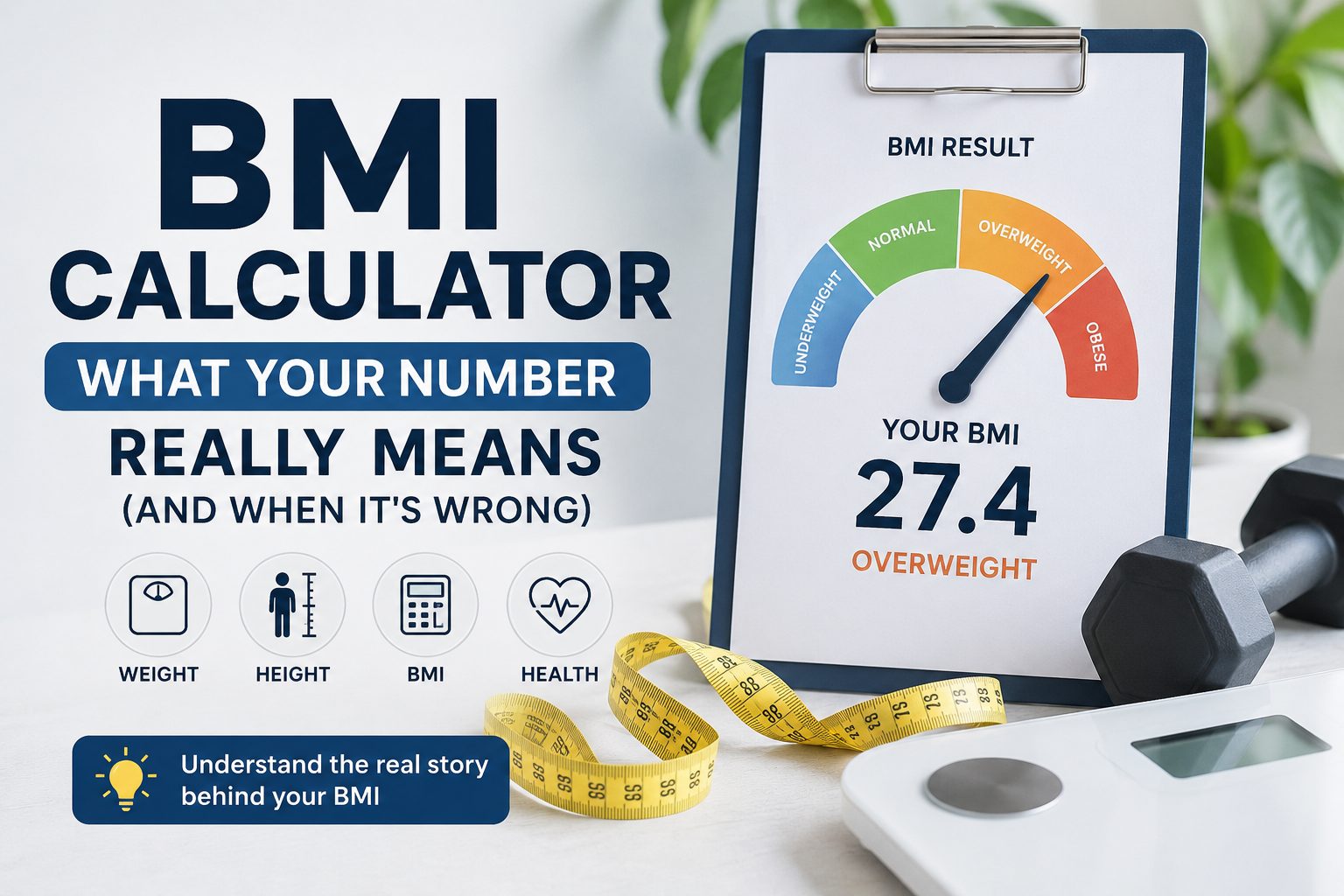
Your BMI came back as 27. Or maybe 31. Or 19. And now you're staring at that number wondering if it actually means anything about your health — or if it's just a random figure doctors like to throw around.
Here's the honest answer: it depends. A BMI calculator explained properly is one of the most useful — and most misunderstood — tools in health screening. It can flag a real risk in one person and completely mislead another. Let's break down exactly when to trust it and when to ignore it.
What BMI Actually Measures
BMI, or Body Mass Index, is just a ratio. No fancy science, no scans, no blood work involved.
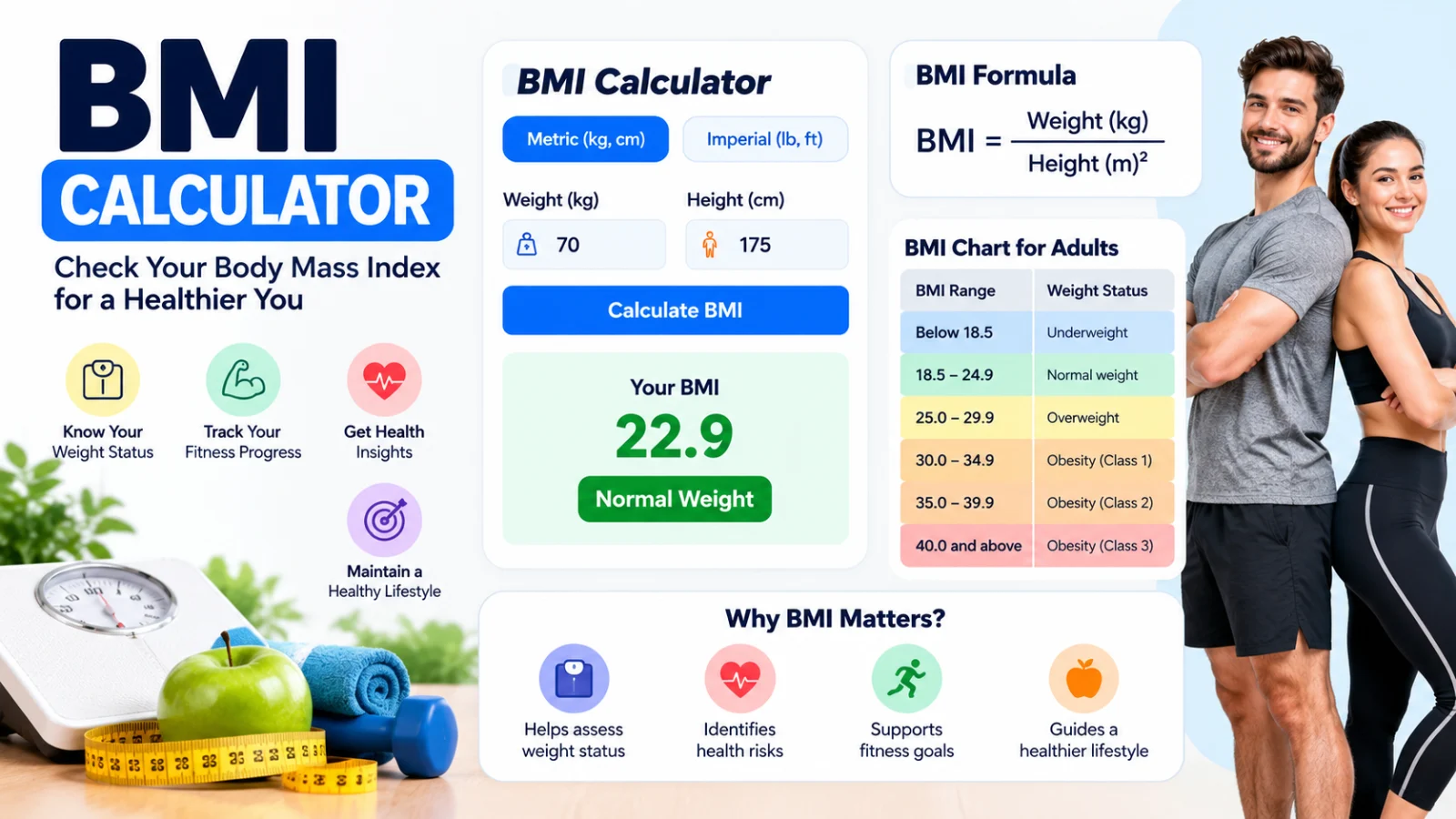
The formula: weight (kg) ÷ height (m)²
If you're working in pounds and inches, it's: [weight (lbs) ÷ height (in)²] × 703
Let's run a quick example. Say someone weighs 70 kg (about 154 lbs) and stands 1.75 m tall (roughly 5'9").
70 ÷ (1.75 × 1.75) = 70 ÷ 3.06 = 22.9
That lands comfortably in the "normal weight" range. Simple enough, right? The math is genuinely that basic — which is exactly why BMI is used everywhere from insurance forms to school health checks. It's fast, free, and doesn't need any equipment beyond a scale and a measuring tape.
If you'd rather skip the manual math, just plug your numbers into the BMI Calculator and get your result instantly, in either metric or imperial units.
Where BMI Falls Apart
This is the part most articles skip over. BMI doesn't know the difference between fat and muscle. It doesn't know your age. It doesn't know if you're pregnant. It's just weight over height, squared — and that blind spot causes real problems.
Athletes and muscular people. A rugby player or a bodybuilder can easily land in the "overweight" or even "obese" category on paper, simply because muscle weighs more than fat per unit of volume. Their body fat percentage might be genuinely low, but BMI has no way of telling. If you fall into this camp, checking your Body Fat Calculator result alongside your BMI gives a far more honest picture.
Older adults. As people age, they tend to lose muscle mass and gain fat — a process called sarcopenia — even if the number on the scale stays exactly the same. So an older adult with a "normal" BMI could still be carrying more fat than is healthy for them, while an athlete's teenage BMI chart doesn't apply the same way to a 70-year-old.
Pregnant women. Pregnancy weight gain is expected and necessary. Running a pregnant woman's numbers through a standard BMI chart and drawing conclusions from it just doesn't make clinical sense — this population needs entirely different growth and weight benchmarks.
Different ethnic backgrounds. The World Health Organization itself has acknowledged that BMI cut-offs don't apply uniformly across populations. Research has shown that some Asian populations face higher health risks at lower BMI thresholds than the standard cut-offs suggest, which is why several health bodies now recommend adjusted risk thresholds for certain groups.
None of this means BMI is useless. It means it's a screening tool — a first filter, not a final verdict. WHO's own classification (underweight, normal, overweight, obese) was designed for population-level health tracking, not as a personal diagnostic for every individual case.
BMI is a screening tool, not a diagnostic one — consult a doctor for personalized health advice, especially if your number seems off given your body type, activity level, or life stage.
So What Should You Actually Do With Your Number?
Treat BMI as one data point, not the whole story. If your number looks unusual for your situation, pair it with other measurements:
- Your Ideal Weight Calculator result, which factors in frame size and gives a range instead of one rigid number.
- Your Body Fat Calculator reading, which separates muscle from fat.
- Your BMR Calculator number, which tells you how many calories your body burns at rest — useful if BMI has you second-guessing your diet.
- Your daily hydration needs via the Water Intake Calculator, because weight management isn't just about calories in and out.
Waist circumference, body fat percentage, and how you actually feel day to day often tell a more complete story than one ratio ever could.
FAQs
Is BMI accurate for muscular people? Not really. Muscle adds weight without adding fat, so BMI often overestimates health risk for people with high muscle mass. Body fat percentage is a better indicator in these cases.
What is a healthy BMI range? For most adults, 18.5–24.9 is classified as "normal weight" by WHO standards. Below 18.5 is underweight, 25–29.9 is overweight, and 30+ falls into the obese category. These ranges are guidelines, not absolutes.
Does BMI differ by age or gender? The formula itself stays the same, but how you should interpret the result does change. Older adults may have a "normal" BMI while still carrying more fat than muscle. Some health guidelines also suggest slightly different risk thresholds for men versus women due to natural differences in body composition.
Can BMI be wrong even if I'm not an athlete? Yes. Bone density, water retention, pregnancy, and even ethnicity can all shift what a "normal" BMI should look like for you specifically. It's a starting point, not a personal medical judgment.
Should I ignore my BMI completely? No — that's overcorrecting. BMI is still a decent, quick screening number for the general population. Just don't treat it as gospel if your body composition doesn't fit the average assumption it's built on.
Check your number with the BMI Calculator, but read it alongside your body fat percentage and how you actually feel — not as a standalone verdict on your health
Get new calculators & guides by email
Occasional updates when we add a new calculator or publish a useful guide. No spam, unsubscribe anytime.
By subscribing you agree to our Privacy Policy.