Area Calculator: How to Find the Area of Any Shape
Learn how to find the area of any flat shape, from rooms and plots to circles and triangles, with simple formulas, worked examples and a free calculator.
Sanjay Singh
Published on 20 Nov 2026 • Updated on 20 Nov 2026
How much sod covers the backyard? How much paint does a wall need? How big is that plot of land? All of these come down to one measurement: area.
This guide explains what area is, gives you the formula for each common shape, works through real examples, and shows how to convert between square feet, square meters, acres and more. If you just need the number, the free Numrexo Area Calculator gives it to you in seconds.
What is area?
Area is the amount of flat space inside a two-dimensional shape. Length measures one direction; area measures two, so it is always written in square units:
- square inches (sq in) for small items like tiles and screens
- square feet (sq ft) for rooms, decks and homes
- square yards (sq yd) for carpet and turf
- acres for land
- square meters (m²) and hectares in the metric system
How to use the Numrexo Area Calculator
- Pick a shape from the menu: square, rectangle, circle, triangle, parallelogram or trapezoid.
- Enter the measurements the shape asks for, such as length and width, or the radius of a circle.
- Use one unit for every side. Convert inches to feet first if you need to (12 inches = 1 foot).
- Press Calculate Area to see the result instantly.
- Share or save it. You can send the result to someone with one tap.
The calculation runs in your browser, so nothing you enter is stored.
Area formulas for common shapes
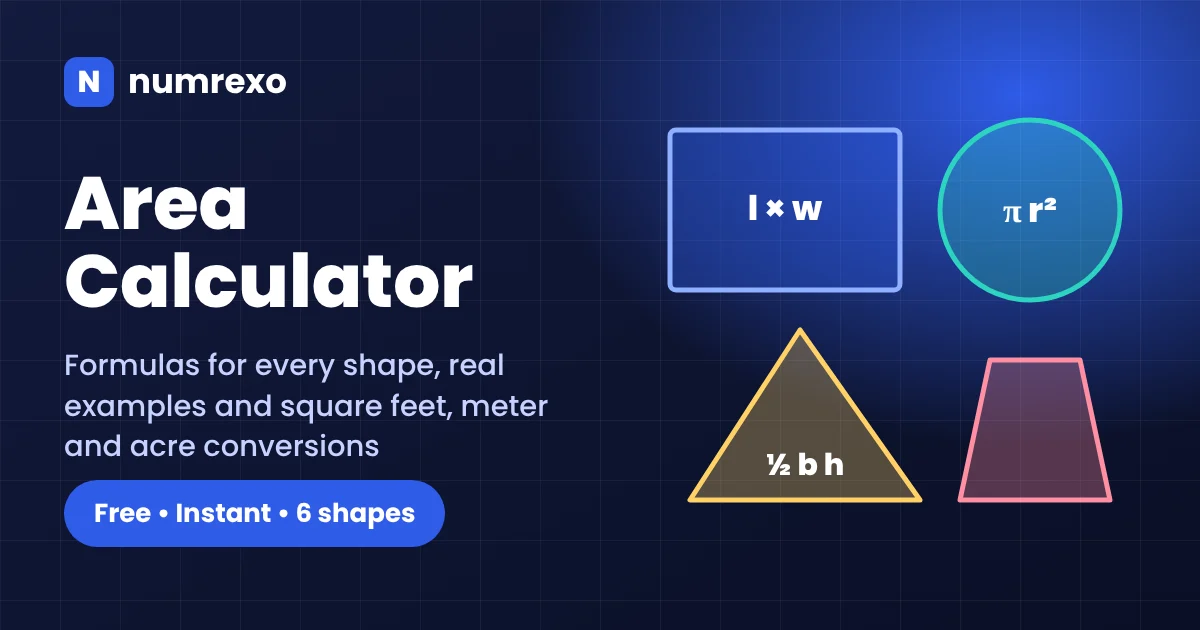
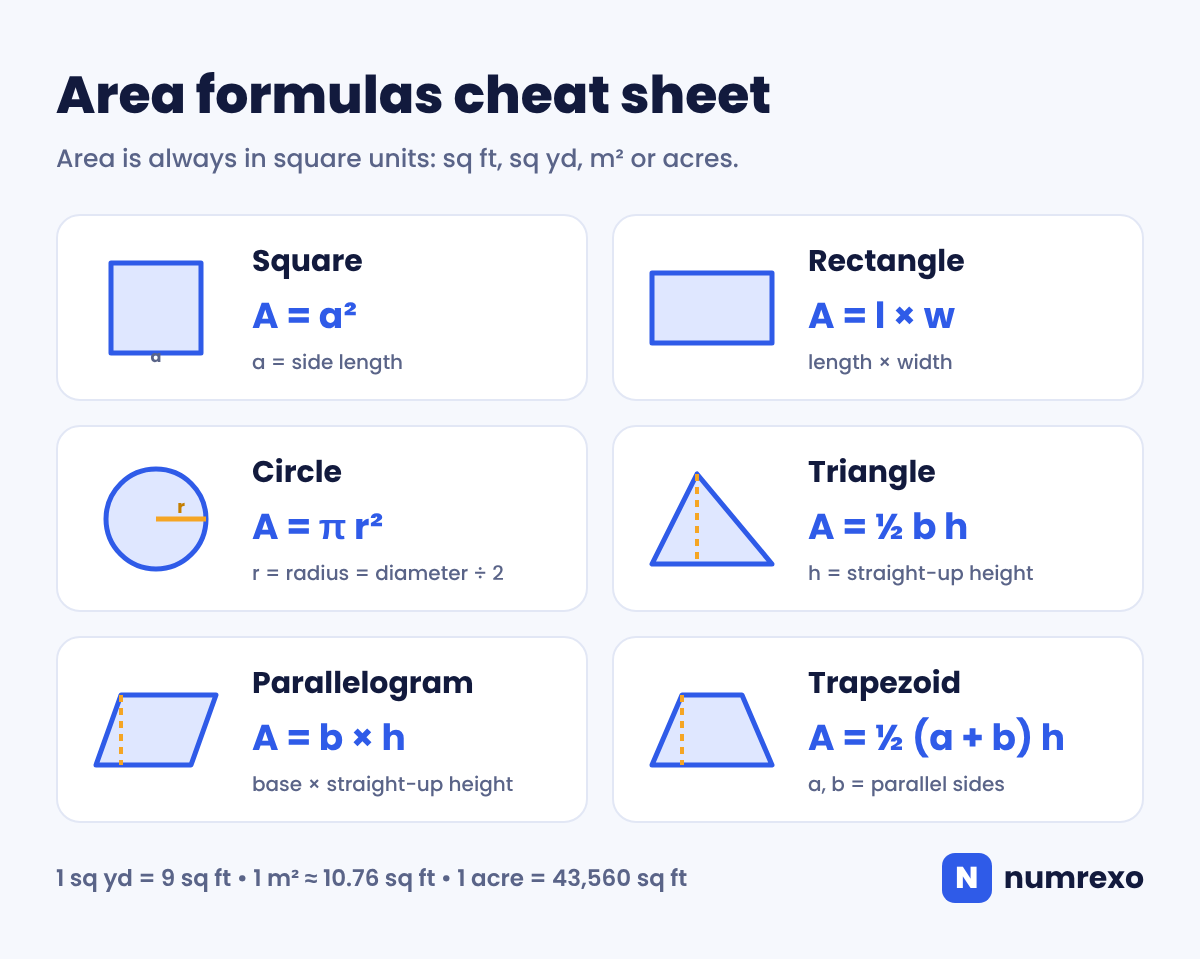
- Square: A = a², where a is the side length.
- Rectangle: A = length × width.
- Circle: A = π × r², where r is the radius (half the diameter).
- Triangle: A = ½ × base × height. The height is measured straight up from the base, not along a slanted side.
- Parallelogram: A = base × height, again using the straight-up height.
- Trapezoid: A = ½ × (a + b) × h, where a and b are the two parallel sides.
Tip: odd shapes, such as an L-shaped room, can be split into rectangles and triangles. Work out each piece, then add them together.
Worked examples
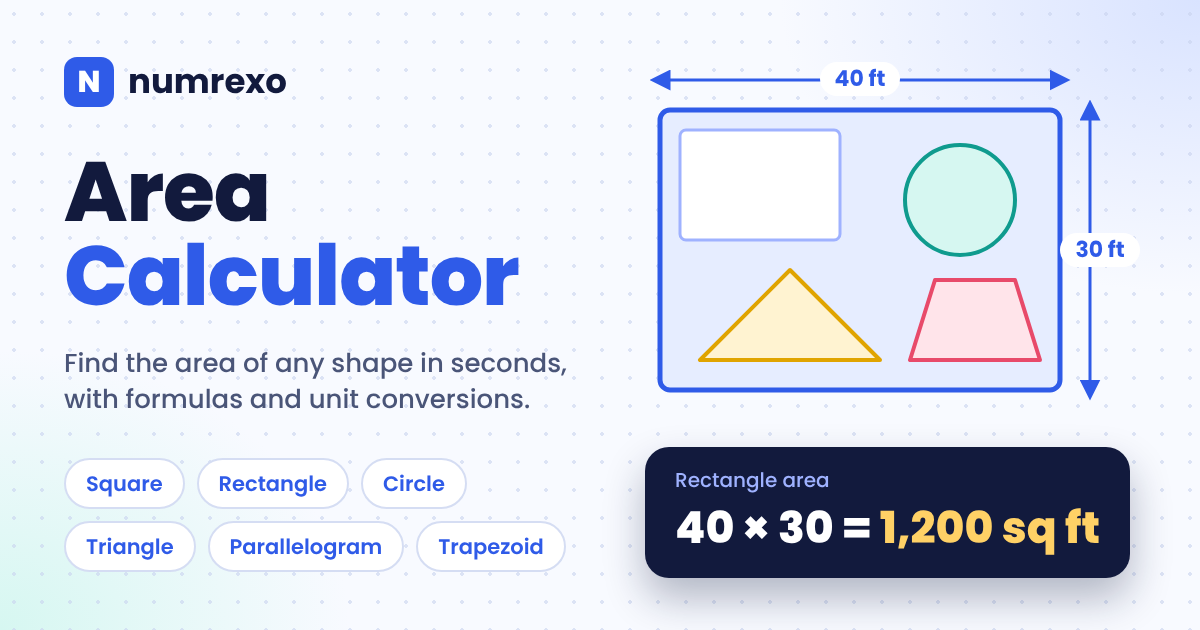
Example 1: Sod for a rectangular lawn
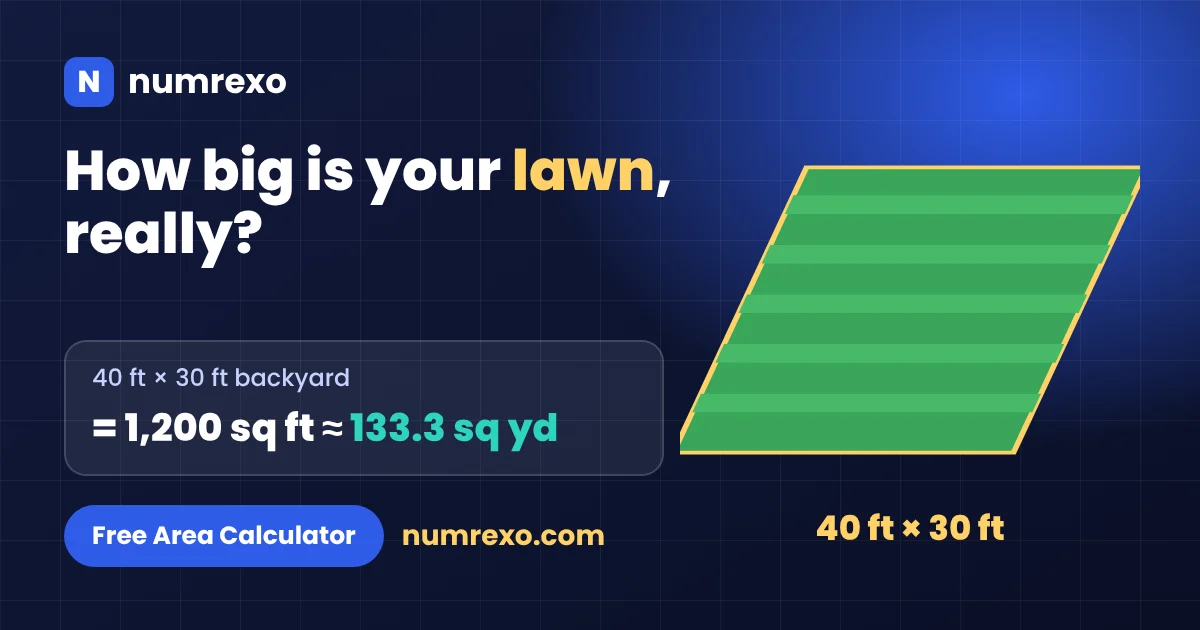
A lawn is 40 ft long and 30 ft wide.
- Area = 40 × 30 = 1,200 sq ft
- In square yards: 1,200 ÷ 9 = about 133.3 sq yd
- In square meters: 1,200 × 0.0929 = about 111.5 m²
Example 2: A round patio
A circular patio is 12 ft across.
- Radius = 12 ÷ 2 = 6 ft
- Area = π × 6² = π × 36 = about 113.1 sq ft
Example 3: Painting a triangular gable wall
The triangle at the top of a wall has a base of 10 ft and a height of 8 ft.
- Area = ½ × 10 × 8 = 40 sq ft of wall to paint
Example 4: A trapezoid garden bed
A raised bed has parallel sides of 10 ft and 6 ft, and is 4 ft deep.
- Area = ½ × (10 + 6) × 4 = 32 sq ft
Example 5: A slanted parking space
An angled parking bay is a parallelogram with a base of 12 ft and a straight-up height of 5 ft.
- Area = 12 × 5 = 60 sq ft
Area unit conversions
- 1 square foot = 144 square inches
- 1 square yard = 9 square feet
- 1 square meter = about 10.76 square feet
- 1 acre = 43,560 square feet
- 1 hectare = 10,000 square meters = about 2.47 acres
Remember: to convert square units, square the length conversion. There are 3 feet in a yard, so there are 3 × 3 = 9 square feet in a square yard, not 3.
Common mistakes to avoid
- Using the diameter instead of the radius. For a circle, halve the diameter first. Using the full diameter makes the answer four times too big.
- Using the slanted side as the height. For triangles and parallelograms, the height must be measured at a right angle to the base.
- Mixing units. Multiplying feet by inches gives a meaningless number.
- Converting square units like regular units. 1 sq yd is 9 sq ft, not 3.
- Forgetting the ½. Triangles and trapezoids both need it.
Where you will use area in everyday life
- Home projects: flooring, carpet, paint, tiles and wallpaper
- Outdoors: sod, mulch, fencing plans and patios
- Real estate: comparing room sizes, homes and plots of land
- School: geometry homework and checking answers
Try the free Area Calculator
Open the Numrexo Area Calculator, pick your shape and get the answer instantly. Need to go from area to boxes of flooring? Try the Flooring Calculator. Working in three dimensions? Use the Volume Calculator.
Frequently Asked Questions
How do you calculate area?▾
Multiply the measurements the shape needs. For a rectangle that is length × width; for a circle it is π × radius²; for a triangle it is ½ × base × height. The answer is always in square units.
How do I find the area of a room in square feet?▾
Measure the length and width in feet and multiply them. A 12 ft by 14 ft room is 12 × 14 = 168 sq ft. For an L-shaped room, split it into rectangles and add the areas.
What is the formula for the area of a circle?▾
A = π × r², where r is the radius, or half the diameter. A circle 12 ft across has a radius of 6 ft, so its area is π × 36, about 113.1 sq ft.
How do I find the area of a triangle?▾
Multiply the base by the height and divide by 2. The height must be measured straight up from the base, not along a slanted side. A triangle with a 10 ft base and 8 ft height has an area of 40 sq ft.
How many square feet are in an acre?▾
One acre is 43,560 square feet, which is about 4,047 square meters.
How do I convert square feet to square meters?▾
Multiply square feet by about 0.0929, or divide by about 10.76. For example, 1,200 sq ft is about 111.5 m².
How many square feet are in a square yard?▾
Nine. A square yard is 3 ft × 3 ft, so it holds 3 × 3 = 9 square feet. Divide square feet by 9 to get square yards.
What is the difference between area and perimeter?▾
Area is the space inside a shape, measured in square units. Perimeter is the distance around its edge, measured in regular units. A 12 × 14 ft room has an area of 168 sq ft and a perimeter of 52 ft.
How do I find the area of an irregular shape?▾
Break it into simple shapes such as rectangles, triangles and half-circles. Find the area of each piece, then add them together, or subtract any cut-out parts.
Is the Numrexo Area Calculator free?▾
Yes. It is free to use with no sign-up, and the calculation runs in your browser, so the numbers you enter are not stored.
Get new calculators & guides by email
Occasional updates when we add a new calculator or publish a useful guide. No spam, unsubscribe anytime.
By subscribing you agree to our Privacy Policy.