Flooring Calculator: How Much Flooring Do You Need?
Learn how to measure a room, add the right waste allowance and turn square feet into boxes and cost, with worked examples and a free calculator.
Sanjay Singh
Published on 20 Nov 2026 • Updated on 20 Nov 2026
Buying new flooring starts with one question: how much do I actually need? Order too little and you are stuck waiting for another box, which may come from a different batch with a slightly different color. Order too much and you have paid for planks that sit in the garage.
This guide shows you how to measure any room, how much extra to add for cuts and mistakes, and how to turn square feet into boxes and a budget. If you just want the answer, use the free Numrexo Flooring Calculator and get it in seconds.
How to measure a room for flooring
All you need is a tape measure, a notepad and a few minutes.
- Measure the length and width of the room at the widest points, wall to wall.
- Round up to the next half foot or inch. Rooms are rarely perfectly square.
- Include closets and doorways that will get the same flooring.
- Split odd shapes into rectangles. An L-shaped room is just two rectangles added together.
- Subtract large fixed items such as a kitchen island or built-in cabinets, because no flooring goes under them.
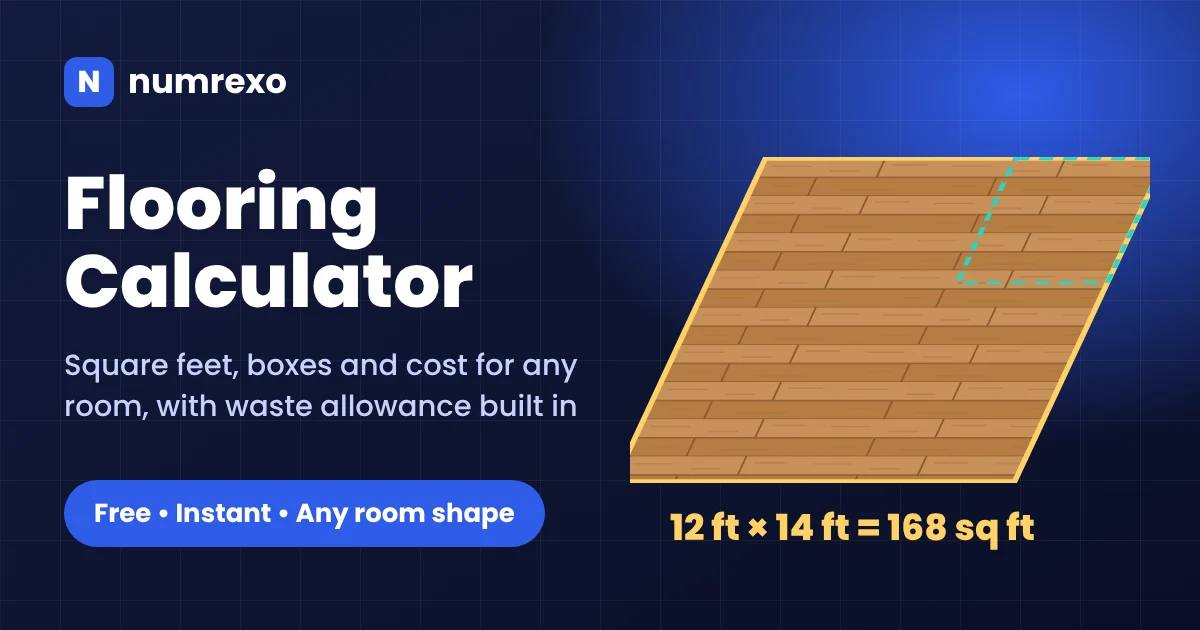
The basic formula is simple:
Floor area (sq ft) = length (ft) × width (ft)
How to use the Numrexo Flooring Calculator
- Enter the room's length and width. Use feet, or meters if you prefer metric.
- Add a waste percentage. 10% is a safe starting point for most rooms (see the next section).
- Enter the coverage per box printed on the flooring box, for example 20 sq ft per box.
- Add the price per square foot or per box if you want a cost estimate.
- Calculate to see the total area, the number of boxes to buy and the estimated cost.
How much extra flooring should you buy?
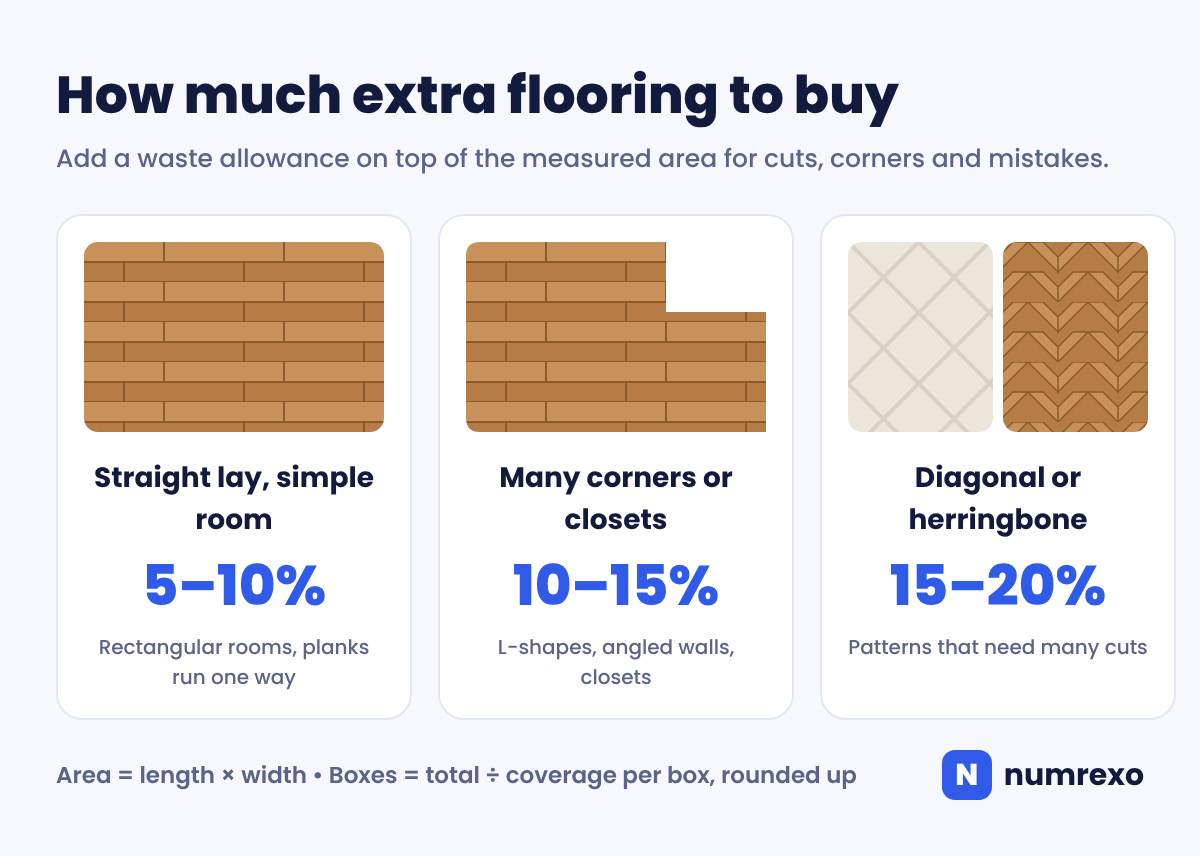
Every floor needs cuts at walls, doorways and corners, and some pieces get damaged. That is why installers add a waste allowance on top of the measured area. A common rule of thumb:
- 5–10% extra for a simple rectangular room with planks laid straight
- 10–15% extra for rooms with lots of corners, closets or angled walls
- 15–20% extra for diagonal or herringbone patterns, which need many more cuts
Keep the leftover box or two. If a plank is damaged years later, you will have an exact color match.
Worked examples
Example 1: A standard bedroom
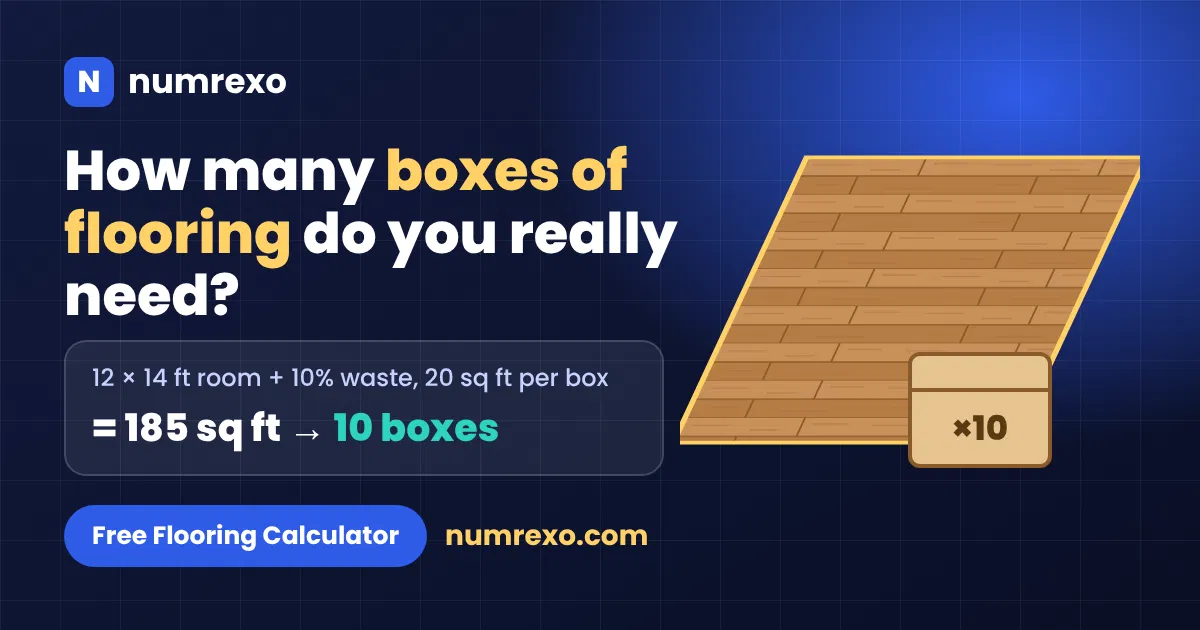
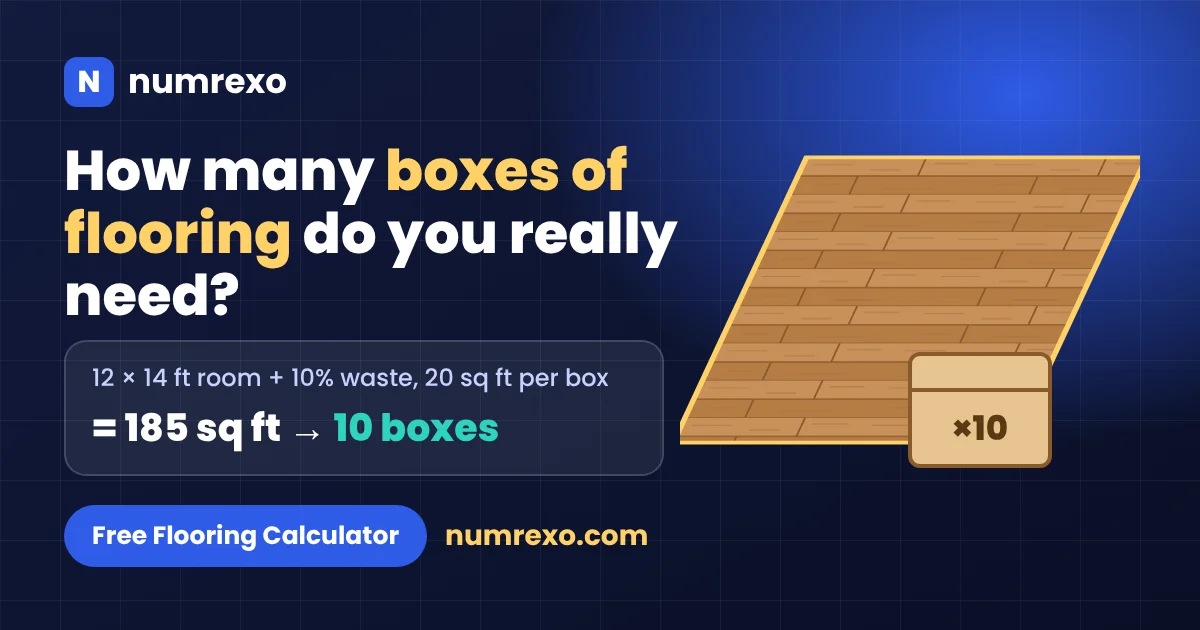
A bedroom is 12 ft by 14 ft, and the laminate comes in boxes that cover 20 sq ft.
- Area = 12 × 14 = 168 sq ft
- Add 10% waste: 168 × 1.10 = 184.8 sq ft, round up to 185 sq ft
- Boxes: 185 ÷ 20 = 9.25, so buy 10 boxes (200 sq ft)
- At an example price of $3.50 per sq ft: 200 × $3.50 = $700 for the flooring
Notice the cost is based on what you buy (10 full boxes), not just what you measured.
Example 2: An L-shaped living room
Split the room into two rectangles:
- Part A: 12 ft × 10 ft = 120 sq ft
- Part B: 8 ft × 6 ft = 48 sq ft
- Total = 120 + 48 = 168 sq ft, plus 10% waste = about 185 sq ft
Example 3: Tile laid on a diagonal
The same 168 sq ft room with tile laid diagonally needs about 15% extra:
- 168 × 1.15 = 193.2, so plan for about 194 sq ft of tile
Example 4: A room measured in meters
A room is 3.5 m by 4.2 m, and each box covers 1.8 m².
- Area = 3.5 × 4.2 = 14.7 m²
- Add 10% waste: 14.7 × 1.10 = 16.17 m²
- Boxes: 16.17 ÷ 1.8 = 8.98, so buy 9 boxes
To switch units: 1 square meter = about 10.76 square feet.
Don't forget these extras
- Underlayment: usually needed under laminate and floating vinyl. Buy the same square footage as the floor.
- Baseboards or quarter-round trim: measured around the room's edge (the perimeter), not by area. For a 12 × 14 ft room the perimeter is 2 × (12 + 14) = 52 ft, minus door openings.
- Transition strips: one for each doorway where the new floor meets a different floor.
- Installation: if you hire an installer, labor is usually priced per square foot and quoted separately from materials.
Common flooring mistakes to avoid
- Measuring only the middle of the room. Walls are rarely straight. Measure at the widest point.
- Skipping the waste allowance. It is the most common reason people run short.
- Buying boxes from different batches. Colors can vary between production runs, so buy everything at once.
- Forgetting closets. A closet floor can add 10–20 sq ft to a bedroom.
- Rounding boxes down. Always round up to the next full box.
Try the free Flooring Calculator
Instead of doing this by hand for every room, open the Numrexo Flooring Calculator, enter your measurements and get the area, boxes and cost in seconds. Need the area of an unusual shape first? The Area Calculator handles circles, triangles and more.
Frequently Asked Questions
How do I calculate how much flooring I need?▾
Multiply the room's length by its width to get square feet, then add 5–15% for waste depending on the layout. Divide the total by the coverage per box and round up to the next full box.
How much extra flooring should I buy for waste?▾
Around 10% is a common rule of thumb for a simple room with planks laid straight. Plan for 15–20% for diagonal or herringbone patterns, or rooms with many corners.
How many boxes of flooring do I need for a 12 × 14 room?▾
12 × 14 = 168 sq ft. With 10% waste that is about 185 sq ft. If each box covers 20 sq ft, 185 ÷ 20 = 9.25, so you need 10 boxes.
How do I measure an L-shaped room?▾
Split it into two rectangles, measure each one, and add the two areas together. For example, 12 × 10 ft plus 8 × 6 ft is 120 + 48 = 168 sq ft.
Do I need flooring under cabinets or a kitchen island?▾
Usually not. Subtract the area of fixed cabinets or an island from your total. Check your flooring's installation guide, because some floating floors have specific rules around heavy fixtures.
Get new calculators & guides by email
Occasional updates when we add a new calculator or publish a useful guide. No spam, unsubscribe anytime.
By subscribing you agree to our Privacy Policy.