Volume Calculator: How to Find the Volume of Any 3D Shape
Learn how to find the volume of a cube, box, cylinder, sphere, cone or pyramid, with simple formulas, real-life examples and a free calculator.
Sanjay Singh
Published on 13 Nov 2026 • Updated on 13 Nov 2026
How much water fits in that fish tank? How many bags of concrete does the patio need? How much soil fills a raised garden bed? Every one of these is a volume question, and every one has a simple formula behind it.
This guide explains what volume is, gives you the formula for every common 3D shape, works through real-life examples, and shows how to turn the answer into gallons, liters or cubic yards. If you just want the number, use the free Numrexo Volume Calculator and get the answer in seconds.
What is volume?
Volume is the amount of three-dimensional space an object takes up, or the amount it can hold. Length is measured in one direction and area in two, but volume is measured in three: length, width and height.
That is why volume is written in cubic units:
- cubic inches (in³) for small objects like boxes and jars
- cubic feet (ft³) for rooms, tanks and appliances
- cubic yards (yd³) for concrete, gravel, mulch and soil
- cubic centimeters (cm³) and cubic meters (m³) in the metric system
Liquids are usually measured in gallons or liters. These are volume units too, just with different names.
How to use the Numrexo Volume Calculator
- Choose the shape that matches your object, for example a box (rectangular prism), cylinder or sphere.
- Enter the measurements the shape asks for, such as length, width and height for a box, or radius and height for a cylinder.
- Use one unit for every side. If one side is in feet and another in inches, convert first (12 inches = 1 foot).
- Press Calculate to see the volume in cubic units.
- Convert if you need to. Use the conversion list further down to turn the answer into gallons, liters or cubic yards.

Volume formulas for common 3D shapes
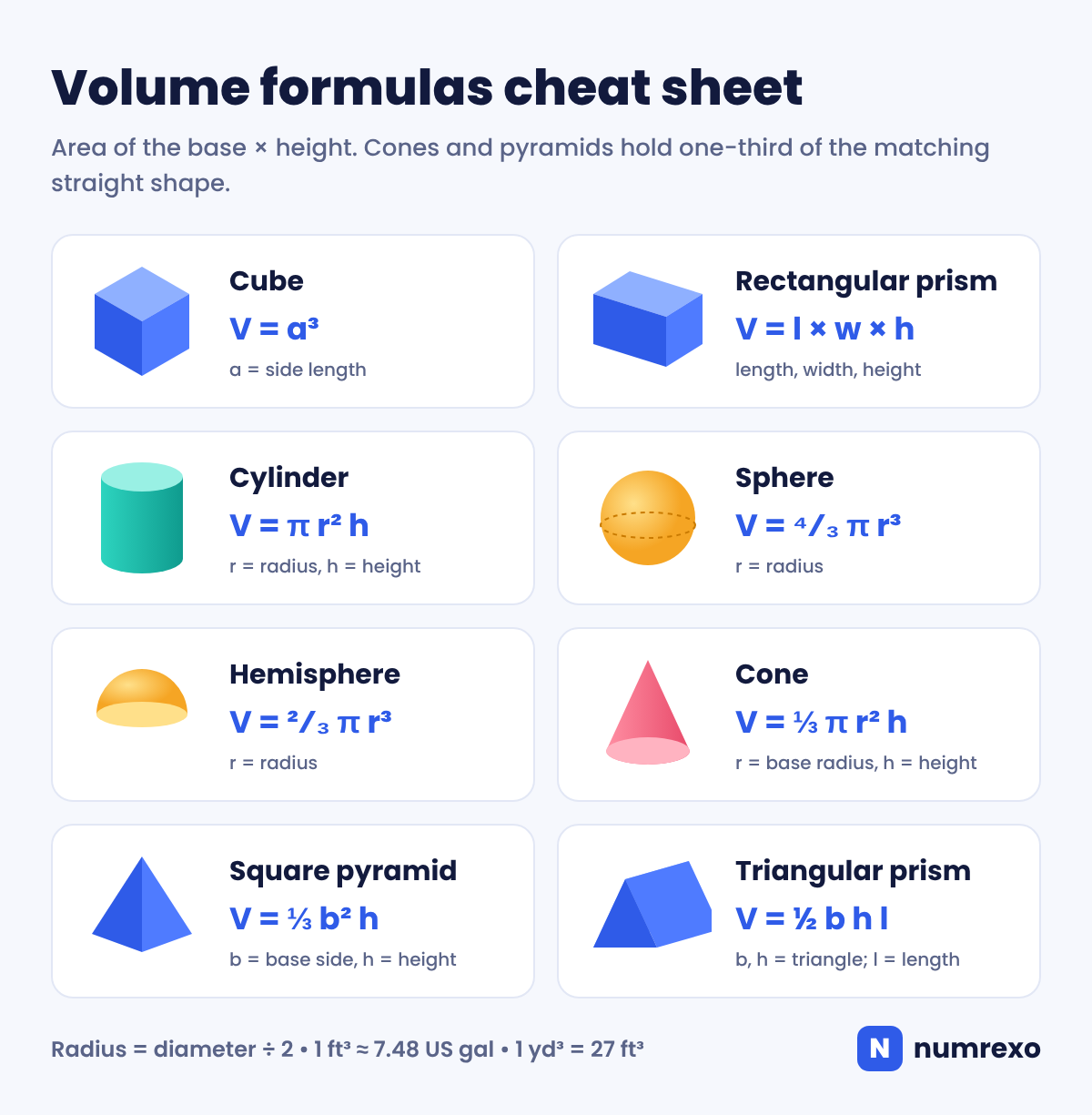
Every volume formula is a version of one idea: the area of the base multiplied by the height. Pointed shapes such as cones and pyramids hold exactly one-third of the matching straight-sided shape.
- Cube: V = a³, where a is the side length. Example: dice, ice cube, storage cube.
- Rectangular prism (box): V = l × w × h. Example: room, shipping box, aquarium.
- Cylinder: V = π × r² × h, where r is the radius. Example: water tank, soda can, pipe.
- Sphere: V = (4/3) × π × r³. Example: basketball, globe.
- Hemisphere: V = (2/3) × π × r³. Example: bowl, dome.
- Cone: V = (1/3) × π × r² × h. Example: funnel, ice cream cone, sand pile.
- Square pyramid: V = (1/3) × b² × h, where b is the base side. Example: tent, roof section.
- Triangular prism: V = ½ × b × h × l, where b and h belong to the triangle and l is the length. Example: wedge doorstop, ramp.
Tip: the radius is half the diameter. If you measured straight across a tank or pipe, divide that number by 2 before using the formula.
Worked examples from real life
Example 1: How many gallons does a fish tank hold?
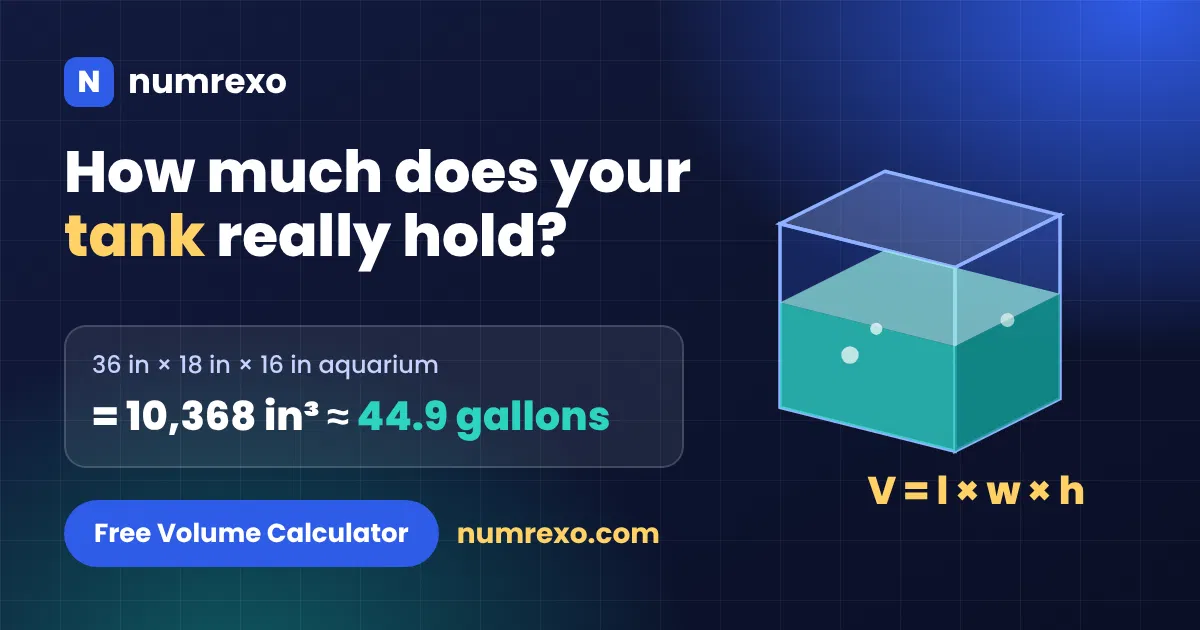
A rectangular aquarium is 36 in long, 18 in wide and 16 in tall.
- Volume = 36 × 18 × 16 = 10,368 cubic inches
- One US gallon is 231 cubic inches, so 10,368 ÷ 231 = about 44.9 gallons (about 169.9 liters)
The real amount is a little less, because you never fill a tank to the brim, and gravel and decorations take up space.
Example 2: How much concrete do you need for a patio slab?
A slab is 12 ft long, 10 ft wide and 4 in thick.
- Change the thickness to feet: 4 ÷ 12 = 0.333 ft
- Volume = 12 × 10 × 0.333 = 40 cubic feet
- Concrete is sold by the cubic yard, and 1 cubic yard = 27 cubic feet: 40 ÷ 27 = 1.48 cubic yards
- Add about 10% for spills and uneven ground: 1.48 × 1.1 = about 1.63 cubic yards to order
Example 3: How much water does a round tank hold?
A cylindrical rain-water tank is 4 ft across (diameter) and 5 ft tall.
- Radius = 4 ÷ 2 = 2 ft
- Volume = π × 2² × 5 = 62.83 cubic feet
- One cubic foot holds about 7.48 US gallons: 62.83 × 7.48 = about 470 gallons (about 1,779 liters)
Example 4: What is the volume of a basketball?
A basketball has a radius of about 4.5 in.
- Volume = (4/3) × π × 4.5³ = (4/3) × π × 91.125 = about 381.7 cubic inches
Volume unit conversions
Once you have the volume, these conversions turn it into the unit you actually buy or use:
- 1 cubic foot = 1,728 cubic inches
- 1 cubic foot = about 7.48 US gallons
- 1 cubic foot = about 28.32 liters
- 1 cubic yard = 27 cubic feet
- 1 US gallon = 231 cubic inches = about 3.785 liters
- 1 cubic meter = 1,000 liters = about 35.31 cubic feet
- 1 liter = 1,000 cubic centimeters
Watch out: the UK (imperial) gallon is bigger than the US gallon, about 4.546 liters. All gallon figures in this guide are US gallons.
Common mistakes to avoid
- Mixing units. Multiplying feet by inches gives a meaningless number. Convert everything to one unit first.
- Using the diameter instead of the radius. For cylinders, spheres and cones, halve the diameter. Using the full diameter makes a cylinder's answer four times too big, and a sphere's eight times too big.
- Forgetting the 1/3. Cones and pyramids hold one-third of the matching cylinder or box.
- Measuring the outside of a container. For capacity, measure the inside. Thick walls can take away a surprising amount of space.
- Ordering exactly what you calculated. For concrete, soil or mulch, add 5–10% extra for waste and settling.
Where you will use volume in everyday life
- Home projects: concrete for slabs and footings, soil for raised beds, mulch for garden paths
- Water: pools, hot tubs, aquariums and water tanks
- Moving and storage: comparing box sizes and how much a truck or storage unit holds
- Cooking and baking: scaling recipes to a different pan size
- School: geometry homework and checking answers step by step
Try the free Volume Calculator
Instead of working through each formula by hand, open the Numrexo Volume Calculator, pick your shape, enter the measurements and get the answer instantly. Working on a floor, wall or plot instead? The Area Calculator handles flat shapes the same way.
Frequently Asked Questions
How do you calculate volume?▾
Multiply the area of the shape's base by its height. For a box that is length × width × height. Cones and pyramids hold one-third of that, and spheres use (4/3) × π × r³.
What is the formula for the volume of a cylinder?▾
V = π × r² × h, where r is the radius (half the diameter) and h is the height. A tank 4 ft across and 5 ft tall holds about 62.83 cubic feet, or about 470 US gallons.
How do I convert cubic feet to gallons?▾
Multiply cubic feet by about 7.48 to get US gallons. For example, 10 cubic feet is about 74.8 gallons. For liters, multiply cubic feet by about 28.32.
How many cubic feet are in a cubic yard?▾
There are 27 cubic feet in one cubic yard, because a cubic yard is 3 ft × 3 ft × 3 ft. Divide cubic feet by 27 to get cubic yards, the unit concrete and soil are sold in.
What is the difference between volume and capacity?▾
Volume is the space an object takes up. Capacity is how much a container can hold inside it. For a thin-walled tank they are almost equal, but for thick containers you should measure the inside to find capacity.
Get new calculators & guides by email
Occasional updates when we add a new calculator or publish a useful guide. No spam, unsubscribe anytime.
By subscribing you agree to our Privacy Policy.